A Tribute to Steve Jobs
The passing of Steve Jobs on 5 October 2011 has affected all of us involved with IT to some extent, whether we use Apple products or not. Jobs was an innovator who changed consumer interaction with computing and how computer products are developed. As working IT professionals, the Cutter Business Technology Council recognizes Jobs’s genius and his impact on today’s computing environment. Each contributor to this omnibus Council Opinion shares his or her personal tribute to the computing pioneer who was Steve Jobs.
A LONG, FORGOTTEN BREAKFAST CONVERSATION BY ISRAEL GAT
One of the things Bill Gates and Steve Ballmer excelled at was delivering joint talks to senior Microsoft managers. The two were incredibly good at reading each other's minds. Steve could easily finish a sentence Bill started and vice versa. There was authentic consistency to the messages they jointly delivered. The two of them, of course, knew it -- and "preached" to us frequently.
Prior to one of these briefings sometime in the early 2000s, I was having breakfast with a few other Microsofties in whatever resort Microsoft took us to. It so happened that most of the hungry souls at my table were working on the first version of the Xbox at the time. Naturally, the conversation revolved around how great the Xbox would be. The overarching sentiment: "We are going to transform the world!"
One of the development managers at the table -- an ex-Apple manager -- was recounting in infinite detail a big clash she had had with Steve Jobs in a previous life. I don't recall the exact details of what the clash was about, but generally it involved a lack of balance between various components of Lisa. The user requirements Jobs placed on the development team were not only infeasible in her opinion, they were plain crazy. Conversely, she thought the Xbox requirements, ambitious that they might have been, were in the realm of the feasible and demonstrated the feet-on-the-ground culture of Microsoft. Numerous jokes were cracked at the table at the expense of Jobs and his "dreams."
There was no way at the time for the Apple vs. Microsoft conversation to reach definitive closure. The Xbox had not been launched, and its market response was yet to be seen. Needless to say, none of us had a clue what transformative products Jobs might have had up his sleeve.
This long-forgotten episode came back twice to me during the past week. First, when my wife broke the sad news to me about Steve Jobs's passing, I literally recalled the dismissive expression about user requirements from Jobs on the face of the ex-Apple manager during that breakfast.
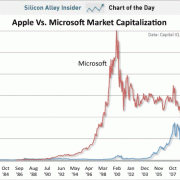
A few days later, the recollection hit me again like a gale-force wind when I saw the Business Insider's Chart of the Day for 6 October 2011 (see Figure 1). 1
Figure 1 -- 6 October 2011 Chart of the Day. (Source: Business Insider.)
Both times, I could not help feeling that the unfinished conversation over breakfast 10 years ago has been brought to a very proper closure.
1Yarow, Jay. "Chart of the Day: Steve Jobs Lived to See Apple Triumph over Microsoft." Business Insider, 6 October 2011 (www.businessinsider.com/chart-of-the-day-steve-jobs-saw-apple-triumph-over-microsoft-2011-10).
AN EPITAPH FOR A DIFFICULT MAN BY KEN ORR
It's rumored that Steve Jobs was a difficult man. I say rumored because I never met Jobs so I don't know from personal experience whether he was all that difficult. What I do know is that some people I know who personally worked with Apple during the late 1990s thought he was. One of those people remarked that whenever Jobs left a meeting, all discussion about the topic at hand simply stopped. Everybody at Apple, it seemed, knew that unless Jobs was present, no decisions were going to be made.
Jobs was rumored to be a perfectionist as well. People say, for example, that Jobs held up the release of the iPod until there was a satisfying click when the user inserted the connector for the earphones. That may not seem too important to most people, but it resonates with my wife. A couple of years ago, we installed a new dishwasher that gave no indication it was going to start until it actually started. You can press all the buttons and close the door multiple times (the necessary sequence), but then it takes what seems to be an eternity before anything happens. What happens, it turns out, is that it's super-heating the hot water -- but there's no satisfying click with that. That dishwasher design team could have used Steve Jobs.
Jobs was rumored not to be a fan of focus groups either. It's rumored that he thought he knew what people "really wanted" better than any collection of demographically selected bystanders. (Here, he was in good company; as I recall, Mr. Akio Morita, the founder of Sony, once remarked that if you are trying to build a truly new product, focus groups are not much help.)
Jobs was also rumored not to be as obsessed with personal wealth as he was in designing and marketing really cool stuff. This may account for the fact that although Apple was the most valuable company (in terms of stock value) in the world at the time of his death, Jobs was only worth something like US $8 billion. This paltry sum, compared to the net worth of the likes of Bill Gates or Larry Ellison, was the result of the poor contract Jobs negotiated when he agreed to return as CEO of Apple for $1 a year.
Jobs was also rumored not to be a fan of "open architectures." He was further rumored to have been a fanatic about controlling every element of design, manufacturing, marketing, and support of "his products."
Finally, Jobs was an intensely private person. This is no rumor. He maintained that his private life, even his health, was nobody else's business. While many financial reporters thought this wrong, Mr. Jobs, being the difficult man that he was, got his way.
With all this negative data about the man, it's hard to understand why Jobs's widely anticipated death has been so universally devastating. People act as if someone really important -- someone truly unique -- has passed. People act as if there was, and will be only be, one Steve Jobs. Perhaps this means that the world can forgive someone who's really, really difficult if that person had the ability to create innovative, useful, and beautiful things. In this manner, Steve Jobs takes his place on the stage of really difficult geniuses: Pablo Picasso, Henry Ford, Frank Lloyd Wright, and so forth -- people who lived life on their own terms and believed that somehow history would forgive their few character flaws. We will all miss Steve Jobs.
REMEMBERING A GENIUS BY LOU MAZZUCCHELLI
Like some members of the Cutter Council, I was lucky to have had the opportunity to meet and work with Steve Jobs when I was an analyst on Wall Street covering the PC industry.
I had been a lone voice on the Street arguing that Apple could recover from its "beleaguered" state prior to Apple's acquisition of NeXT. Steve's return with that acquisition added an ironic dimension that evolved into one of the great corporate turnarounds in history.
While I had engaged from a distance through Apple investor relations and conference calls, my first one-on-one meeting with Steve came just after Apple had reported its first profitable quarter since his return. Apple had scheduled an analysts meeting in Cupertino, California, USA, and all of us dutifully shuttled out to hear what Apple management had to tell us about its plans for the future.
When I was introduced to Steve, he recognized me from my public efforts on Apple's behalf, and thanked me for my support during Apple's tough times. Those of you who know me might imagine my response. Figuring I might never get the chance again, I told Steve, "Thanks for not f**king it up." My host wilted. Steve grinned.
Shortly after, Apple included a quote from me in a press release announcing its advertising strategy for the iMac. This was one of the only times a non-Apple voice was included in an Apple corporate release, and I'm sure it would not have happened without Steve's approval. While many have described Steve's darker side, many of us can equally cite examples of gracious behavior like this.
I remember vividly Steve's personal demonstration to me of Mac OS X prior to its announcement, and his focused energy directed at convincing me that the "lickable" new Aqua interface was the greatest thing in the world. Many have seen Steve live on stage or in a video announcing new products; I can only say that it was even more impressive up close, and I enjoyed all my professional interactions with him throughout my tenure on the Street.
When I heard of his passing, my immediate thought was:
Talent hits a target no one else can hit;
Genius hits a target no one else can see.
-- Arthur Schopenhauer
Schopenhauer didn't live to see Steve Jobs, but maybe he predicted him.
THE MAN WHO CREATED THE WIND BY LYNNE ELLYN
I was extremely saddened by the passing of Steve Jobs. I first met Steve when I worked for Chrysler Corporation in the early 1990s. I attended an amazing conference focused on the future of technology sponsored by Lotus (before IBM acquired it). This conference was held in Boston and featured several luminaries, most notably the incredible Isaac Asimov and Nobel Laureate Arno Penzeas. All the speakers were astounding, but Steve Jobs stole the show. He was young, bright, and so persuasive that words cannot describe his effect on the audience. He believed in his vision to a degree that meant you had to believe along with him. I managed to chat with Steve for a few minutes and found him intense but cordial. He answered a few questions for me, and I shook his hand. I have always "felt" the energy of other people, and his energy was remarkable. I was inspired.
Over the years, it was clear that Jobs provided the whole IT industry with challenge and inspiration. Without Apple nipping at the heels of Microsoft and showing what true innovation looks like, the IT industry would have suffered from stagnant and user-malignant technology. Only the few challengers thrown at Microsoft, such as Sun, Netscape, and Apple, preserved the technical momentum. But the only challenger to survive the crushing monopoly of Microsoft was Apple. There are several reasons why Apple did not succumb to Microsoft's dominance, and all those reasons are really about Steve Jobs.
Jobs had vision. Jobs had passion. Jobs listened to his own inner voice and eschewed all the mindless Wall Street formulas, the pompous pundit advice, and the "market" wisdom. He never sacrificed quality or creativity to quarterly earnings announcements. Jobs did not ask which way the wind was blowing -- he created the wind.
Even the "failures" that Jobs experienced were brilliant. When I managed the Advanced Technology Group at Chrysler, I had the 0.9 release of the NeXt computer. It was amazing, compelling, and beautiful in design and function. Throughout my career, I have had every type of desktop available -- Sun, Apollo, Windows, TI Explorer, Symbolics, OS/2 -- you name it. Without a doubt, the most intriguing desktop I have ever experienced was that NeXt machine. Today, my personal devices are an iMac and a MacBook Air. Both exhibit the same incredible design characteristics of the failed NeXt machine and are arguably more advanced. The NeXt machine was a market failure but a design advancement that lives on. User interfaces and OO programming technology owe much to being inspired by NeXt.
The revolution in handheld computing and consumer products also would have never happened without the iPod, iPhone, and iPad. Lots of "similar" devices have been around for some time, but it took the brilliant and uncompromising Steve Jobs to really make them happen.
Jobs truly cared about the user interface, and he cared about the creative process. His inspiring Apple designs led to incredible changes in how people work in graphic design, photography, and fashion design. By creating graceful and intuitive interfaces, Apple products have enabled the nonprogrammer community to do creative work. We take all this for granted today, but these advances are clearly attributable to the innovative genius of Steve Jobs and his leadership at Apple.
Everyone will say that Jobs will be missed. Many will observe that his kind of genius will likely not show up again -- for decades. They are undoubtedly right. This makes me sad.
YOU WERE RIGHT ALL ALONG BY ROBERT D. SCOTT
I never had the pleasure of meeting Steve Jobs in person. But his impact on my life reaches all the way back to the mid-1980s when, as a young IT manager, his Apple IIc was key to the PC introduction at Procter & Gamble. We were all struggling to understand if PCs were going to be something relevant or just a passing fad. One of my responsibilities back then was to create a computer literacy program for executives who wanted to know about these new machines. To this day, I still remember the advice my then CIO told the P&G CFO: "If you have to choose between a personal computer and a row boat, I'd take the row boat." This was the first salvo in an ongoing battle that Jobs and Apple started within corporate IT departments. It was framed like this:
- Mac vs. PC
- Apple vs. Microsoft
- Open architecture vs. closed architecture
- Form vs. function
- The individual vs. the establishment
Of course, the issue was not any of these -- and all of them. Jobs created a cult following of people who believed in Apple; and yes, it was form and function. This battle continued for the next 30 years, repeated over and over as Jobs/Apple introduced one disruptive innovation after another. Each one triggered a pitch battle as the establishment (corporate IT, the music industry, etc.) fought to maintain world order -- or control. And each time, the mountain eventually crumbled.
As one of the original corporate IT "guardians of the gate" determined to keep the Apple heathens at bay, I humbly say today: Steve, you were right all along. I just wish we could have come together to collaborate earlier and more elegantly. Who knows what other marvels may have emerged.
THIS IS ABOUT ME BY JAMES ROBERTSON
This is not about Steve Jobs; this is about me. Or, if I am going to be precise, the part of me that has been changed by being exposed to the design thinking of Jobs. My way of working and living has been unconsciously, subtly, and profoundly influenced and altered by the designs that Jobs brought about at Apple.
This is not about the toys. Sure, I use a Mac and an iPhone and an iPad and most of the others -- that's not the point. The point is that I learn from these things. I learn how things can be seductive and convenient to use. Amazingly convenient, when I look at how all the pieces slot neatly into place and work harmoniously within a seamless infrastructure. I learn from Apple's relentless attention to detail, and I try and emulate it. I learn from the wonderful graphic design on Apple's website, its sparse user manuals (who needs much of a manual when the thing works just as you expected it to?), and the Apple interfaces. I learn from Jobs's presentations, and I try to make my presentations -- the layout and the patter -- more like his.
The Jobs Design Thinking (I think this phrase deserves capitalization) insists that every device must slide in under its user's hands and do something valuable for that user. And the device just does it; no fuss, no fiddling, no learning, no instructions, no need to ask, "How does this thing work?" But best of all is that before the user saw it, he neither knew that he wanted the device nor did he imagine that he wanted to do whatever it is that the device helps him do. Only Jobs and Apple knew that he wanted to do it.
When I was a young boy, my father let me use his hand tools. I loved the shapes of the various wood-shaping tools, the way that a sharp plane blade would peel off a perfect ribbon of wood from the edge of a board, the heft of a beautifully balanced hammer or saw. I still love my tools, but now those are tools that Jobs Design Thinking brought me: Apple devices and applications along with applications that exist only because Apple exists.
I love my work, and I love the way that I can get results I did not dream possible before I felt the influence of Jobs Design Thinking. Thank you, Steve Jobs, for making me a better craftsman. And thank you for making me smile as I work.
THANK YOU, STEVE JOBS BY MATTHEW BINKOWSKI
I, like many who have benefitted from the genius of Steve Jobs, can't imagine what my life would have been like had he stopped pursuing greatness. What would the world be like today if he had given up after being fired from Apple? What if he chose to leave the technology space altogether after such a public dismissal? What if he hadn't founded NeXT and created the core of the next generation of Macintosh computers? For a while, we had a taste of that alternate universe; a myriad of beige boxes from every corner of the universe and a flurry of Windows releases that were so far from inspired, I don't know where to begin.
Apple's innovations help me every single day. So frequently, in fact, that I have to force myself to stop and take notice. Just last week, I was working on a project and needed to brainstorm with a creative partner in Shreveport, Louisiana, USA. I emailed him using my MacBook Pro and asked if he could do a video iChat. In a matter of seconds, he was showing me paper sketches and gesturing movements through our interface. He then held up his smartphone to the built-in iSight camera in his MacBook Pro to demo an augmented reality app he and his colleagues were developing. While chatting, I emailed him a PDF of my presentation made in Apple's Keynote. A moment of silence suddenly came upon us. Looking into the camera, I said to him, "Do you remember when we were in college? What we're doing right now would have been impossible!" He replied, "I know! This is Buck Rogers stuff!" Despite our collective imaginations, the thought of emailing presentations, easy-to-use live video chats, or powerful laptops that handled everything with ease was never in our wildest dreams. We laughed realizing that life was surreal -- and real at the same time.
I collect rare Apple hardware. I own a prototype Apple Interactive TV set-top box, a Newton 2100 and 130, an eMate, and a developer edition of Pippin. I own those devices because they are beautiful reminders that life is about more than just "going with the flow." These machines represent the embodiment of the idea that being creative is about trying something new. Something difficult. Something worthwhile. You're right if you're thinking, "Wait a minute, those weren't created during Steve's tenure as CEO." People love to think of those products as failures or flops. I don't. I see them as brilliant examples of Apple's innovative what-if culture that Jobs created and, remarkably, endured despite his absence. To me, an organization that continues to push the boundaries in ways that redefine or create industries -- without a fearless leader -- speaks volumes.
If the time between his CEO tenure at Apple is any indication, I'm more than confident that his spirit will continue to inform and inspire Apple employees, Apple products, and legions of insanely grateful Apple customers for a long time to come.
On behalf of those who prefer the bar held high, thank you Steve. You will never be forgotten.
Sincerely,
One of the Crazy Ones
A SENSE OF PASSION BY RON BLITSTEIN
I choose not to write a hymn to Steve Jobs. Those that knew him have infinitely better insight and deserve that privilege. I also choose not to write about his effect on society since unless someone has been living in the remotest of places, Jobs's impact on computing, consumer electronics, animated movies, and the music industry is well known and obvious. Instead, I offer a few quotes that align with my sense of who Steve Jobs was, how he worked, and his passion. To begin, here's one from Jobs:
Ultimately it comes down to taste. It comes down to trying to expose yourself to the best things that humans have done and then trying to bring those things into what you're doing. I mean Picasso had a saying. He said good artists copy, great artists steal. And we have always been shameless about stealing great ideas, and I think part of what made the Macintosh great was that the people working on it were musicians and poets and artists and zoologists and historians who also happened to be the best computer scientists in the world. 2
In Jim Collins's book Good to Great, he offers an interesting paradox by sharing that "good is the enemy of the great. And that is one of the key reasons why we have so little that becomes great." 3 Collins's words underscore the uncompromising nature of greatness. The quote that follows from entreprenuer Perry Metzger's Google+ page flows from a similar spring:
[Jobs] showed that, in spite of the myriad of people who believe otherwise, you really can change the world by being brilliant and insisting on the highest standards of quality. You don't have to settle for crap. You don't have to accept second raters. You will even be rewarded for it.
Amidst the oceans of enforced mediocrity in the bland, deflavorized culture of managed-by-committee corporate behemoths, where process is constantly used as an inadequate substitute for competence, he showed that the real path to excellence was excellence -- that you could do great things by, who would have imagined, being smart and having excellent taste and not ever settling for second best.
Jobs was recognized as having an almost maniacal intensity and focus. He was known to chew out subordinates and partners who failed to deliver; he made great sport of trashing Microsoft; and he ignored the pundits. His vision reshaped the computer, telephone, and entertainment industries. No compromises were acceptable. He has been quoted as telling an engineer that "you've baked a really lovely cake, but then you've used dog shit for frosting."
I am especially fond of Jobs's views of Microsoft, which are encapsulated in the following quote:
The only problem with Microsoft is they just have no taste, they have absolutely no taste, and what that means is -- I don't mean that in a small way I mean that in a big way. In the sense that they don't think of original ideas and they don't bring much culture into their product and you say why is that important -- well you know proportionally spaced fonts come from typesetting and beautiful books, that's where one gets the idea -- if it weren't for the Mac they would never have that in their products and so I guess I am saddened, not by Microsoft's success -- I have no problem with their success, they've earned their success for the most part. I have a problem with the fact that they just make really third-rate products. 4
I am not sure how many of you read the satirical news rag The Onion. If not, you should wander to its site every now and again. It has a biting perspective on social events and is much funnier than the tabloids that line the supermarket checkout aisles. I close my tribute to Jobs with a headline from The Onion with apologies for its crudeness: "Last American Who Knew What the Fuck He Was Doing Dies."
2 Triumph of the Nerds: The Rise of Accidental Empires. PBS, June 1996.
3 Collins, Jim. Good to Great: Why Some Companies Make the Leap ... and Others Don't. HarperBusiness, 2001.
4 PBS. See 2.