Strategic advice to leverage new technologies
Technology is at the heart of nearly every enterprise, enabling new business models and strategies, and serving as the catalyst to industry convergence. Leveraging the right technology can improve business outcomes, providing intelligence and insights that help you make more informed and accurate decisions. From finding patterns in data through data science, to curating relevant insights with data analytics, to the predictive abilities and innumerable applications of AI, to solving challenging business problems with ML, NLP, and knowledge graphs, technology has brought decision-making to a more intelligent level. Keep pace with the technology trends, opportunities, applications, and real-world use cases that will move your organization closer to its transformation and business goals.
Insight
In this edition, we check in on the status of enterprise systems and infrastructure transformation. As usual, we've got lots of good survey data to help you assess where you are similar and where you are different from others engaged in IT transformation.
Executive Report
Making Enterprise Integration Real
Editor's note: This Executive Report is the second in a two-part series on enterprise integration (EI). The first, "Enterprise Integration: Business's New Frontier" (see Distributed Enterprise Architecture Executive Report, Vol. 4, No. 12), covers the rationale and architecture for enterprise integration.
Executive Update
Web Services Paradigm
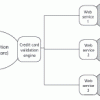
A Web service is a programmable entity that provides a particular element of functionality, such as application logic, and is accessible to any number of potentially disparate systems through the use of Internet standards, such as XML and HTTP.
As the next revolutionary advancement of the Internet, Web services will become the fundamental structure that links together all computing devices.


The idea of the Semantic Web first became popular with the publication of an article by Tim Berners-Lee, James Hendler, and Ora Lassila in the May 2001 issue of Scientific American (" The Semantic Web," www.scientificamerican.com/2001/0501issue/0501berners-lee.html).
Executive Report
Achieving a High-Quality Data Resource
Background
I attended John Zachman's ZIFA Conference in Phoenix, Arizona, USA, in the fall of 1999 (ZIFA stands for the Zachman Institute for Framework Advancement). During the conference, John and I were discussing the current state of affairs in IT, specifically the burgeoning rate of disparity in all aspects of the field.
Executive Summary
Achieving a High-Quality Data Resource
The data resource in most public-and private-sector organizations is in a state of disarray. The quantities of disparate data are increasing rapidly, and these disparate data cannot be readily integrated to meet the demand for the information needed to support dynamic business activities.