
Business Transformation Requires Transformational Leaders
Leadership and teaming skills are front and center in times of rapid change. Meet today’s constant disruption head on with expert guidance in leadership, business strategy, transformation, and innovation. Whether the disruption du jour is a digitally-driven upending of traditional business models, the pandemic-driven end to business as usual, or the change-driven challenge of staffing that meets your transformation plans — you’ll be prepared with cutting edge techniques and expert knowledge that enable strategic leadership.
Subscribe to Arthur D. Little's Culture & Leadership Newsletter
Insight
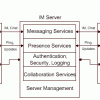
Instant messaging (IM) has rapidly moved from an Internet fad to the boardroom -- or nearly so. Over the past few years, corporate use of IM has exploded, with estimates suggesting that nearly 30% of IM daily traffic of the large service providers -- AOL, MSN, and Yahoo -- is related to corporate use. Mounting evidence, including a recent Cutter survey, corroborates these findings.


How many of us wrestle with the question "who should report to whom?" several times a year? Have your efforts to "reorganize" the business-technology relationship been proactive or reactive? Often, because some influential people complain about the relationship, things change. But reactive changes usually don't last long.
How much are you spending on technology? Who pays for what? How do you determine funding responsibilities? And how do you determine how to pay for infrastructure, applications, R&D, and ongoing technology management? These are huge issues -- especially when you consider that the US spends more than one trillion dollars a year on hardware, software, and services. Yes -- a trillion dollars!

How many of us wrestle with the question "who should report to whom?" several times a year? Have your efforts to "reorganize" the business-technology relationship been proactive or reactive? Often, because some influential people complain about the relationship, things change. But reactive changes usually don't last long.