Business Transformation Requires Transformational Leaders
Leadership and teaming skills are front and center in times of rapid change. Meet today’s constant disruption head on with expert guidance in leadership, business strategy, transformation, and innovation. Whether the disruption du jour is a digitally-driven upending of traditional business models, the pandemic-driven end to business as usual, or the change-driven challenge of staffing that meets your transformation plans — you’ll be prepared with cutting edge techniques and expert knowledge that enable strategic leadership.
Subscribe to Arthur D. Little's Culture & Leadership Newsletter
Insight

Web services are facing an identity crisis. Burdened with the misleading "Web services" moniker and discussed primarily in technical circles, the business world doesn't know what to make of the concept. Are Web services little more than an incremental, evolutionary improvement in systems integration techniques, or do they truly mark a revolutionary paradigm shift in the application of information technology?
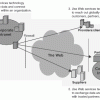
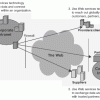
Web services are collections of functions bundled together to deliver functionality to Internet-enabled desktops and Web applications. They represent a way for applications to communicate with each other automatically over the Internet. The goal is the streamlining of business processes by allowing software applications to be delivered and run across all kinds of computers, from large servers to handheld devices.
Web services promise to reduce costs and minimize management complexity of corporate IT services, as more solutions are shifted to scalable, managed outsourcing environments. Web services are in use today under a variety of names, and they will only expand in value as the market matures. The concept of Web services is quite old; you will hear it referred to as a return to the mainframe/data center model of old.
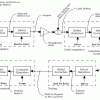

If software were defect-free, we could effectively cut development effort by almost half. 1 Even more compelling, if there were no defects in our software, we could reallocate most of the maintenance and support resources to developing new features rather than fixing defects.

Executive Update
Leveraging the Internet During Outsourcing
During Cutter Consortium's annual surveys on outsourcing in 2001 and 2002, survey recipients were asked if and how they were using the Internet to manage their outsourcing relationships. The results are in, and they indicate that employing the Internet for the various aspects of outsourcing is still in somewhat of a growth mode.