


Business Transformation Requires Transformational Leaders
Leadership and teaming skills are front and center in times of rapid change. Meet today’s constant disruption head on with expert guidance in leadership, business strategy, transformation, and innovation. Whether the disruption du jour is a digitally-driven upending of traditional business models, the pandemic-driven end to business as usual, or the change-driven challenge of staffing that meets your transformation plans — you’ll be prepared with cutting edge techniques and expert knowledge that enable strategic leadership.
Subscribe to Arthur D. Little's Culture & Leadership Newsletter
Insight

Domain
Organizational Matters

Business-IT alignment is critical to the near-term profitability and long-term success of your enterprise. Business-IT alignment is achieved when business requirements, strategy, infrastructure, and processes are synchronized with each other and with IT infrastructure, data, systems, and processes.

Executive Update
E-Business Success Factors
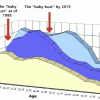

TIDES AND POPULATION
If you've spent much time at the seashore, you're probably familiar with high tides and low tides, and with high-high tide and low-low tide. Where low tide is a phenomenon that occurs every day as the moon passes by, low-low tide happens on those days when the moon and the sun are their absolute farthest distance from the Earth.
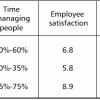
HUMAN CAPITAL MANAGEMENT ISSUES
Businesses are now competing in two markets, one for their products and services and one for the talent required to produce or perform them. A company's success in its business markets is determined by its success in the talent market. At the very time that business markets are expanding, talent markets seem to be shrinking. As the knowledge required to build products and deliver services increases, the retention of experienced employees becomes critical to improving productivity and time to market.

© 2001 by Johanna Rothman. All rights reserved.
Software organizations take forever to hire technical people, we overwork them, our projects are late, we can't get everything done. We must have a people shortage, yes? No.
©2001 SRA International. All rights reserved.
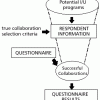
Are you an IT director who has been able to hire a sufficient number of adequately trained software employees in a timely manner? If so, you are in the minority. A recent study commissioned by the Information Technology Association of America (ITAA) indicates that there were 1.6 million open positions for information technology (IT) workers last year, and only half of those positions were likely filled [3].