

Business Transformation Requires Transformational Leaders
Leadership and teaming skills are front and center in times of rapid change. Meet today’s constant disruption head on with expert guidance in leadership, business strategy, transformation, and innovation. Whether the disruption du jour is a digitally-driven upending of traditional business models, the pandemic-driven end to business as usual, or the change-driven challenge of staffing that meets your transformation plans — you’ll be prepared with cutting edge techniques and expert knowledge that enable strategic leadership.
Subscribe to Arthur D. Little's Culture & Leadership Newsletter
Insight

There has been much debate recently over the definition of risk management. Cutter Consortium recently surveyed IT managers about their organizations' risk management practices. Some interesting findings about the definition of risk surfaced.
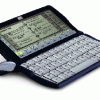
©2000 Symbian Ltd. All rights reserved.

MICROSOFT'S WINDOWS CE: WHY IT CAN COMPETE by Ed Yourdon
As we've noted elsewhere in this issue of the Cutter IT Journal, embedded systems and wireless information devices (WIDs) are likely to become the next major wave of technology.
It is said that the dawn of the personal computer represented the first major computing revolution, and the appearance of the Web marked the second. Now we're standing on the brink of the third great computing revolution -- the advent of the "Internet appliance" (IA).

It's hard to pick up a business magazine or IT trade journal without being bombarded by articles on e-business, e-commerce, e-this, and e-that. It's not only the hot new thing, it seems to be the only thing that organizations are focusing on these days.

The increased interest in mini operating systems at Hewlett-Packard Laboratories (HPL) corresponds, not surprisingly, with the rise of the new enterprise Internet data center (IDC).
For at least a decade, surveys have consistently reported that the very top priority for CIOs and senior managers is that of aligning IT with the business.
As embedded systems become ever more powerful and inexpensive, the range of applications for which they might be suited grows ever larger. Some vendors appear to be concentrating on a relatively narrow niche of handheld personal digital assistants (PDAs), while others -- notably Microsoft -- are focusing on a broader range of business-oriented products and applications.