



Business Transformation Requires Transformational Leaders
Leadership and teaming skills are front and center in times of rapid change. Meet today’s constant disruption head on with expert guidance in leadership, business strategy, transformation, and innovation. Whether the disruption du jour is a digitally-driven upending of traditional business models, the pandemic-driven end to business as usual, or the change-driven challenge of staffing that meets your transformation plans — you’ll be prepared with cutting edge techniques and expert knowledge that enable strategic leadership.
Subscribe to Arthur D. Little's Culture & Leadership Newsletter
Insight
Neuromorphic computing -- computing architectures inspired by the design of brains -- is getting serious attention from large companies. IBM is placing large bets on its Watson technology and bringing applications to several industries as well as leading the way on new types of chips that implement neural networks. Google and Facebook are both applying deep learning networks in software to tagging of images, among other uses. Neuromorphic computing is rising.


This Executive Report examines the transformation taking place in healthcare, research, and medicine -- including key trends and developments around the application of mobile connected devices combined with cloud and big data analysis technologies applied to healthcare, fitness, and wellness programs. It also considers the benefits and issues involved in using sensor and other data acquired from personal mobile devices in conjunction with other forms of medical and healthcare data.

The growing use of personal fitness trackers, smart watches, connected medical devices, and a myriad of sensor-enabled apps running on smartphones is also generating vast amounts of health data about consumers. For the most part, this data has not been used to any real extent by healthcare providers, clinicians, and researchers to promote the overall health and well being of patients and consumers. This is changing, and we are seeing a revolution in healthcare with the application of mHealth ("mobile health") technologies and practices.
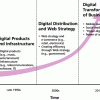


Only 100 years have passed since the Industrial Revolution and we are already in the midst of a new revolution, the latest being of a digital nature.

Both the Lean and Agile worlds encourage and value learning by doing. The Scrum framework pushes teams to engage in an ongoing PDCA (Plan-Do-Check-Act) cycle to continually inspect and adapt how they work and how they develop software.
For Scrum teams, the end-of-sprint review is where they inspect the increment of work they created during the iteration and examine what they have learned about their deliverables. Based on this knowledge, teams can review their upcoming backlog items and adjust when they feel it is necessary.


One of my first tasks upon joining the EA team at Syngenta, a multinational agribusiness company, was to redefine the global architecture governance processes. Among my first tasks after joining the EA team at Syngenta was to redefine the architecture review board (ARB), a need that was triggered by a review of our enterprise architecture program.


The distinctive features of cloud computing offer many potential opportunities for business innovation, particularly given its service (and service quality) focus, coupled with the flexibility that new technology delivery mechanisms provide. However, our most recent research finds good reasons for qualifying the assumption of frictionless innovation arising from cloud adoption. The pattern, instead, may well follow past diffusions of other potentially powerful technological innovations, including the Internet itself.
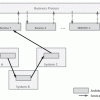

To be faster and cheaper, DevOps should integrate currently separated QA tasks -- from testing done during development to monitoring executed on daily operations routines -- under a common, business-oriented, and actionable QA architecture, designed and built into IT systems. This Executive Report offers such an architecture pattern for IT service assurance.