


Business Transformation Requires Transformational Leaders
Leadership and teaming skills are front and center in times of rapid change. Meet today’s constant disruption head on with expert guidance in leadership, business strategy, transformation, and innovation. Whether the disruption du jour is a digitally-driven upending of traditional business models, the pandemic-driven end to business as usual, or the change-driven challenge of staffing that meets your transformation plans — you’ll be prepared with cutting edge techniques and expert knowledge that enable strategic leadership.
Subscribe to Arthur D. Little's Culture & Leadership Newsletter
Insight
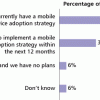

In October and November 2012, Cutter Consortium conducted a survey that asked 69 end-user organizations worldwide about their use of mobile devices, including smartphones and tablets, in order to provide their employees and partners with the ability to interact with business operations, ranging from basic email to CRM and BI while "on the go." Our goal was to

When Robert Solow first said, in 1987, that "you can see the computer age everywhere but in the productivity statistics,"1 it highlighted a perennial problem: the disconnect between the investments made in IT and actual business benefits.

Think back for a moment to the best project experience you have ever had. It may have been in the workplace, part of some team sport you were involved with, or perhaps it was a major trip you undertook with your family. What are the characteristics that made that a great project experience?
Abstract
As we explore in this Executive Report, the days of IT managed as a "cost overhead" need to end.
There has been so much investment in IT by every company over the past years with the intention of making the business more competitive by improving productivity, optimizing the supply chain, enabling e-business, and so on.


The after effects of subtropical storm Sandy, which slammed into northern New Jersey late in October, are still being strongly felt. According to the latest count, some 30,000 businesses and homes in New Jersey and an additional 305,000 homes and 256,000 businesses in New York were destroyed or damaged by the storm.