



Business Transformation Requires Transformational Leaders
Leadership and teaming skills are front and center in times of rapid change. Meet today’s constant disruption head on with expert guidance in leadership, business strategy, transformation, and innovation. Whether the disruption du jour is a digitally-driven upending of traditional business models, the pandemic-driven end to business as usual, or the change-driven challenge of staffing that meets your transformation plans — you’ll be prepared with cutting edge techniques and expert knowledge that enable strategic leadership.
Subscribe to Arthur D. Little's Culture & Leadership Newsletter
Insight
It still amazes me how many enterprise data warehousing/business intelligence (DW/BI) projects struggle, often to the point of paralysis, with the "Inmon/Kimball" debate. This impasse revolves around whether a DW/BI program should insist upon routing all information through a complex, third normal form (3NF) data layer o


I would like to follow up on a story mentioned in my previous Advisor ("Who Watches for the Watchers When the Watchers Don't Watch?" 12 January 2012).
Advisor
Leadership Versus Management
The general literature on leadership is very confusing. There are over 250 different definitions of leadership in the literature! Many of these definitions are not operational in that they don't provide guides to action. What specifically does a leader do? There is confusion over how leadership contrasts with the words "management" and "authority." Educational institutions like the Harvard Business School say their mission is to train leaders, but every professor has his or her own definition of leadership.





Abstract
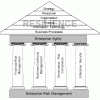
As we explore in this Executive Report, business resilience combines enterprise risk management (ERM) and agility to create robu
Business resilience has become increasingly important in the wake of an unusual period of natural disasters around the globe, and new technologies and organizational models have yielded improved capabilities to move forward in the face of any disaster. Threats, both natural and man-made, continue to proliferate, as all the possibilities of business, financial, and physical risk meet the evolving threat environment of increasingly pervasive IT.
