

Business Transformation Requires Transformational Leaders
Leadership and teaming skills are front and center in times of rapid change. Meet today’s constant disruption head on with expert guidance in leadership, business strategy, transformation, and innovation. Whether the disruption du jour is a digitally-driven upending of traditional business models, the pandemic-driven end to business as usual, or the change-driven challenge of staffing that meets your transformation plans — you’ll be prepared with cutting edge techniques and expert knowledge that enable strategic leadership.
Subscribe to Arthur D. Little's Culture & Leadership Newsletter
Insight
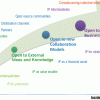
This article revisits the state of open innovation implementation since my last CBR contribution back in 2007.1 I must confess, since my consulting business promotes the concepts of open innovation, I am particularly curious to know to what extent organizations worldwide are adopting such practices. In the first part of this article, I will investigate how much further organization have implemented the open innovation approach since 2007, by comparing and analyzing the results of this year's Cutter Consortium survey with those from four years ago. Next, I will dive into the differences between the survey findings and my professional experience in order to envision the trajectory path of open innovation.

This issue of CBR takes a page out of our multiyear installments in order to benchmark the evolution of an important trend over the last four years. We take a look at open innovation and its change in the understanding of our readership over the 2007-2011 time span.
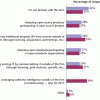

This survey investigated how and to what extent organizations acquire intellectual property (IP) from sources outside of the firm as well as how and to what extent they leverage existing IP by commercializing it outside of the firm. The 65 respondents are from organizations headquartered or based in North America (38%), Europe/Middle East/Africa (25%), Asia/Australia/Pacific (31%), and South America (6%).



It's worthwhile (I think) to have clear language established and agreed upon for any discussion.


Cutter colleague Jens Coldewey recently published a very incisive Advisor entitled "Pitfalls of Agile



In a 2010 Executive Update, I talked about the transition from a document-centric approach to knowledge management (KM) -- with its emphasis on content management systems (CMSs) and search engines -- to "social KM," in which, to quote the title I gave that Update: "It's not (just) what you know; it's who you know." 1