


Business Transformation Requires Transformational Leaders
Leadership and teaming skills are front and center in times of rapid change. Meet today’s constant disruption head on with expert guidance in leadership, business strategy, transformation, and innovation. Whether the disruption du jour is a digitally-driven upending of traditional business models, the pandemic-driven end to business as usual, or the change-driven challenge of staffing that meets your transformation plans — you’ll be prepared with cutting edge techniques and expert knowledge that enable strategic leadership.
Subscribe to Arthur D. Little's Culture & Leadership Newsletter
Insight
This issue of Cutter Benchmark Review benchmarks what's happening in organizations with respect to tablet adoption and use.

This is my fifth contribution to CBR, and it was by far the most difficult survey to prepare. Not the survey itself — the questions that my coauthors and I believe to be interesting and important were obvious to us, and we had no problems harmonizing our thoughts and quickly arriving at a finished product. So what was the struggle? Defining "the tablet."
Article
A Storm Is Coming In
At the very end of the movie The Terminator, Sarah Conner, future heroine of the human race, fills her car with gas at some "out in the middle of nowhere" service station. She knows how the next decades will roll out for the world; she has seen what lies ahead. As the gas tank fills, a man nearby speaks something in Spanish. Sarah then asks the station attendant, "What did he say?"
The attendant replies, "He said there's a storm coming in."
Sarah then sighs and says, "I know."


The most important way to reduce risk in innovation is to establish efficient innovation processes and consider risks versus benefits at each stage of development for new ideas. General practices that can help to build efficiency and reduce tendencies toward a risky "all or nothing" approach include:


Risk management is really tough. It involves thinking the unthinkable and then, because you have thought of the unthinkable, feeling compelled to do something to prepare for it. If the latest Japanese earthquake/tsunami/nuclear reactor disaster teaches us nothing else, it is that if something can go bad, it will.
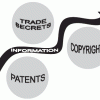
The relationship between intellectual property (IP) rights and innovation is by no means straightforward. While conventional economics dictates that innovation is the route to value creation -- and IP protection provides the means to secure that value -- this formulation breaks down almost at the instant in which it is questioned.
"Frantic," "indecisive," "technology-disabled," "fantasy-driven," "doesn't know what it wants" -- these are only some of the statements provided by IT people when asked to describe their customers. And this is hardly a surprise. In general, IT processes are characterized by long durations and time-consuming efforts. Once assigned to a task, the IT project manager is first asked to "understand the need" (aka requirements management).