


Business Transformation Requires Transformational Leaders
Leadership and teaming skills are front and center in times of rapid change. Meet today’s constant disruption head on with expert guidance in leadership, business strategy, transformation, and innovation. Whether the disruption du jour is a digitally-driven upending of traditional business models, the pandemic-driven end to business as usual, or the change-driven challenge of staffing that meets your transformation plans — you’ll be prepared with cutting edge techniques and expert knowledge that enable strategic leadership.
Subscribe to Arthur D. Little's Culture & Leadership Newsletter
Insight
Whether or not you end up moving forward with the adoption of a new project management methodology, the deliberation that goes into even the consideration of the possibility can be a daunting endeavor. In this issue of CBR, we analyze the results of a survey we conducted of IT and business professionals to gauge their impressions and experiences with Kanban, one of the up-and-comers on the IT scene.
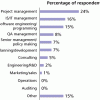

This survey investigated the extent to which organizations are using Kanban in their software development projects and their experience with Kanban. The 83 respondents are from organizations headquartered or based in the US and Canada (43%), Europe and the Middle East (29%), Latin America and Mexico (19%), Asia/Australia/Pacific (7%), and Africa (1%).
Executive Report
Avoiding System Bankruptcy: How to Pay Off Your Technical Debt
Abstract
In life we are all familiar with debt, especially financial debt. The longer a monetary debt is left unpaid, the more interest accrues. Eventually bankruptcy may be declared. Similarly, in software development, every time something is executed incorrectly, it may be thought of as technical debt.
Executive Summary
Avoiding System Bankruptcy: How to Pay Off Your Technical Debt
Debt, especially financial debt, is a familiar concept. The longer a monetary debt is left unpaid, the more interest accrues. Eventually bankruptcy may be declared. Similarly, in software development, every time something is executed incorrectly, it may be thought of as technical debt.


A good contract is important to outsourcing; this is an undisputable statement. The contract is the legal basis of the outsourcing agreement and therefore of fundamental importance. However, there are two different research-based views as to just how important the contract is.


Many managers use the mantra, "do more with less." At the recent Agile 2010 conference, Pat Reed from GAP, who copresented with me, shortened this mantra to "do less." The theme of our presentation was value optimization or, as Pat likes to say, "value imagineering" -- determining the highest-valued chunks of functionality to implement next, whether those chunks are project


In the previous Advisor (see "Seeking Out Systemic Risk," 12 August 2010), I discussed the US Congress's establishment of a Financial Stability Council (FSC), one of the main purposes of which is to put an end to, or at least minimize, the effects of firms considered "too big to fail.