

Business Transformation Requires Transformational Leaders
Leadership and teaming skills are front and center in times of rapid change. Meet today’s constant disruption head on with expert guidance in leadership, business strategy, transformation, and innovation. Whether the disruption du jour is a digitally-driven upending of traditional business models, the pandemic-driven end to business as usual, or the change-driven challenge of staffing that meets your transformation plans — you’ll be prepared with cutting edge techniques and expert knowledge that enable strategic leadership.
Subscribe to Arthur D. Little's Culture & Leadership Newsletter
Insight

IS strategy is the organizational perspective on the investment, deployment, use, and management of information systems.1 Even though each individual business and IS executive may have his or her own particular view of IS, organizational IS strategy reflects the collective view shared across the upper echelon of the organization.2 An IS strategy determines if, when, how, and the extent to which a company will innovate with IS.3 Research by Daniel Chen et al.


During this on-demand webinar, William Ulrich helps you expand the value proposition of your business architecture to facilitate strategic planning, address executive priorities, deliver customer value, leverage investments in major initiatives and deploy horizontal solutions across business units.
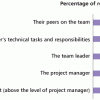


As social networking and Web 2.0 applications continue to enter the workplace and rise in importance, it is crucial to be aware that they bring new risks along with new opportunities. Although relatively few companies have as yet introduced strong codes for using these applications, the risks of unrestricted access are beginning to become apparent.

This is the first Executive Update in a three-part series discussing the variety of ways in which organizations, particularly commercial firms, are leveraging virtual worlds to create and capture value. In this Update, I lay out the conceptual foundation for the discussion.


Last month, I wrote about the difficulty IT organizations have in achieving effective integration with business (see "An Attitude Persists: Thinking Business? -- Hah!" 5 May 2010).


In a bit of technological determinism, Nicholas Carr suggests that the Internet is making us dumber.
In a bit of technological determinism, Nicholas Carr suggests that the Internet is making us dumber.