Business Transformation Requires Transformational Leaders
Leadership and teaming skills are front and center in times of rapid change. Meet today’s constant disruption head on with expert guidance in leadership, business strategy, transformation, and innovation. Whether the disruption du jour is a digitally-driven upending of traditional business models, the pandemic-driven end to business as usual, or the change-driven challenge of staffing that meets your transformation plans — you’ll be prepared with cutting edge techniques and expert knowledge that enable strategic leadership.
Subscribe to Arthur D. Little's Culture & Leadership Newsletter
Insight
There was a time when we had one telephone bill. Each month, AT&T billed us for a certain number of hard-wired telephones and long-distance charges. At that time, we also had a TV antenna mounted on the roof (remember antennas?). Then came cable and satellite TV and the antennas slowly disappeared. For a while, we used our landlines to "dial up" the Internet.

In my last Executive Update, "Enterprise Software Vendors: The State of the Union," 1 I examined the emerging competition for the high-margin business of supporting enterprise applications. In this Update, it's time to look toward the future of enterprise software.




Part I of this two-part Executive Update series showed how cloud computing is maturing to become commoditized across multiple solution and service domains. 1 Here in Part II, we discuss how the CIO of tomorrow becomes a concierge for information services, considers the full breadth of cloud business use case
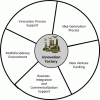

Innovation factories may be characterized as entities whose central function is to encourage, develop, and disseminate innovation through application of some regular process or organization. Innovation factories exist across all industries, though many currently focus on specific areas.

Recall a moment in history: The decisions embodied in the plan were being executed. By the time a seemingly sacrosanct decision was reversed, military casualties exceeded 10,000, as many civilians died from forced evacuation and the starvation that followed. The plan might have ended World War II by Christmas of 1944. Yet Operation Market Garden fell far short of its objectives. It became known as "A Bridge Too Far." 1