



Business Transformation Requires Transformational Leaders
Leadership and teaming skills are front and center in times of rapid change. Meet today’s constant disruption head on with expert guidance in leadership, business strategy, transformation, and innovation. Whether the disruption du jour is a digitally-driven upending of traditional business models, the pandemic-driven end to business as usual, or the change-driven challenge of staffing that meets your transformation plans — you’ll be prepared with cutting edge techniques and expert knowledge that enable strategic leadership.
Subscribe to Arthur D. Little's Culture & Leadership Newsletter
Insight


"The only reliable feature of the torpedo was its unreliability."
So said Theodore Roscoe of the US Navy's Mark XIV torpedo during the early stages of World War II in his book, United States Submarine Operations in World War II (US Naval Institute Press, June 1949).


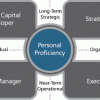

As leadership guru John Kotter notes, "More change always requires more leadership." Effective project managers cannot be reduced to merely what they know (e.g., certification) and do (e.g., processes). So what makes a great project leader?
Value comes from embracing and managing risk. An absence of risk generally equates to an absence of value. But value must be measured, and the results, good and bad, must be analyzed for enterprise learning and to enhance future business developments, particularly with regard to developing more robust and complete business cases and promoting better-informed decision making for the future. A more positive and structured approach to enterprise governance of IT will help ensure the delivery of value. This is best achieved by building on what you have.




In 1980, Michael Porter wrote in his classic book Competitive Strategy: Techniques for Analyzing Industries and Competitors that there are two generic strategies for companies competing in broad markets.


My 16 April 2009 Trends Advisor, "As the 'Net Kills Newspapers, Who Pays for Free?" received more comments than most. It raised the question: who pays for journalism and research when advertising disappears?