

Business Transformation Requires Transformational Leaders
Leadership and teaming skills are front and center in times of rapid change. Meet today’s constant disruption head on with expert guidance in leadership, business strategy, transformation, and innovation. Whether the disruption du jour is a digitally-driven upending of traditional business models, the pandemic-driven end to business as usual, or the change-driven challenge of staffing that meets your transformation plans — you’ll be prepared with cutting edge techniques and expert knowledge that enable strategic leadership.
Subscribe to Arthur D. Little's Culture & Leadership Newsletter
Insight

Computer science is still a relatively young body of knowledge, strongly linked to technology and therefore to the market. This explains why its historical development has followed complex and hardly predictable paths, including strongly emphasized topics soon forgotten (the network computer, just to mention one); promises never realized (fully automatic generation of software); and brilliant concepts that remained almost unknown for many years (object orientation). As it is commonly said, in computer science it is not easy to distinguish the hyper from the hype.


Cloud computing and software as a service (SaaS) have captured plenty of industry and press attention, but they have also created an equal share of confusion and even controversy. While there are solid reasons to be cautious about how to approach these rapidly evolving Web-based alternatives, there is also growing evidence that they are no passing fad. Instead, cloud computing and SaaS represent a fundamental shift in the way technology and business applications will be packaged, priced, delivered, and utilized going forward.

In this issue of CBR, we bring our mixed academic/practitioner approach to benchmarking to the domain of software as a service (SaaS) and cloud computing. These are just two instantiations of a long-time move toward making the ability for a firm to acquire computing resources as a service, as needed, a reality.


This survey investigated software as a service (SaaS) and cloud computing. Sixty-five percent of the 68 respondents who completed both parts of the survey are with organizations headquartered or based in North America; 21% are headquartered or based in Asia/Australia/Pacific; 12% in Europe; and the remainder in the Middle East and Africa.

Abstract
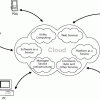
Although still a somewhat ambiguous term, "cloud computing" represents a watershed in both the evolution of outsourced service provision and in data center infrastructure. Public clouds provide outsourced services in a manner that incorporates efficiency, flexibility, scalability, and improvements in charging under a pay-as-you-go utility model.
Cloud computing has become the accepted name for the next evolutionary step of the data center and the services enabled by that infrastructure. It encompasses a range of service capabilities that can be provided to the enterprise and to individuals through a utility computing model by using multiple processors that are managed together as one, with access to services, provisioning, and management through the Internet.


So how can companies work effectively to ensure information security, privacy, and compliance areas collaborate to make initiatives most successful? The authors in this issue attempt to answer that question, addressing a wide range of information security and privacy convergence issues in the process. In fact, we had more than 20 folks who offered to write articles on this topic! Because of the overwhelming response, we are going to dedicate two issues -- this one and another later in the year -- to information security and privacy convergence.

There has been much talk recently regarding a convergence of information security and privacy. Not that this is anything particularly new - convergence has been happening ever since privacy became a concern. After all, privacy requires the implementation of robust information security controls and appropriate safeguards. There are at least 46 privacy breach notice laws in the US alone; understanding and complying with their multiple requirements (to say nothing of the growing number of other national and international privacy laws) will require privacy and information security areas to work together for effective enterprise-wide management.