

Business Transformation Requires Transformational Leaders
Leadership and teaming skills are front and center in times of rapid change. Meet today’s constant disruption head on with expert guidance in leadership, business strategy, transformation, and innovation. Whether the disruption du jour is a digitally-driven upending of traditional business models, the pandemic-driven end to business as usual, or the change-driven challenge of staffing that meets your transformation plans — you’ll be prepared with cutting edge techniques and expert knowledge that enable strategic leadership.
Subscribe to Arthur D. Little's Culture & Leadership Newsletter
Insight

Happy New Year!
For more on agile software development, join Cutter's Agile Software Development and Project Management Advisory Service.
Happy New Year!
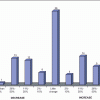
Contrary to the rosier findings of other studies, a recent Cutter Consortium survey of IT decisionmakers shows that IT spending, as a percentage of total organizational expenses, will remain steady, although a bit flat, in 2004. The survey finds that the actual amount of money that corporations plan to spend on IT may increase slightly, but it won't keep pace with inflation or growth in other expenses. Even a slight increase in spending is welcome, but suppliers and IT managers might want to wait a bit before cheering an end to the technology slump.
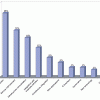
Part I presented an initial analysis of IT spending plans for 2004 based on a 2003 survey of 97 companies. Here in Part II, we try to help you understand how your spending plans compare with our survey sample. To that end, we examined some important demographic and strategic drivers of IT spending and delved deeper into the data by examining respondents' major spending priorities. While 2004 spending plans will, on average, be flat compared to 2003, and while most organizations are in cost-cutting mode for IT, some firms plan to build new technologies and applications.
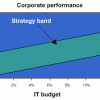
Contrary to common wisdom, the level of IT expenditure should reflect the performance objectives and communication style of a company. Researchers at the InterUnity Group studied 500 companies and found that only a few technologies universally improve corporate performance and that increasing IT expenditures in companies with low levels of IT/business-unit partnership is most often a waste of money. While most companies fail to achieve competitive advantage from their IT strategy, companies with high levels of IT/business-unit partnership outperform others.

A business executive recently told me that IT was too busy focusing on the needs of IT rather than on those of the business community. This user claimed that IT had various projects in the works to consolidate certain databases, address hardware cost performance, deploy new packages, and pursue myriad other projects that did little to recover bottom-line revenue or streamline business costs. This emphasis on IT cost cutting over delivering business value is quite common.