


Business Transformation Requires Transformational Leaders
Leadership and teaming skills are front and center in times of rapid change. Meet today’s constant disruption head on with expert guidance in leadership, business strategy, transformation, and innovation. Whether the disruption du jour is a digitally-driven upending of traditional business models, the pandemic-driven end to business as usual, or the change-driven challenge of staffing that meets your transformation plans — you’ll be prepared with cutting edge techniques and expert knowledge that enable strategic leadership.
Subscribe to Arthur D. Little's Culture & Leadership Newsletter
Insight
Cutter launched its Enterprise Architecture Advisory Service in 1999. It seems appropriate to begin the new year with a brief survey of where this field has come in the last four years.
The most common method of software estimation, according to a recent survey by Cutter Consortium of more than 100 software development organizations of varied sizes, is the very basic technique of using the rough judgment of experienced developers -- the "guru" method.
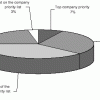

"Slack represents operational capability sacrificed in the interests of long-term (organizational) health." So writes Cutter Business Technology Council Fellow Tom DeMarco in his acclaimed book, Slack: Getting Past Burnout, Busy Work, and the Myth of Total Efficiency (Broadway Books, 2001). In this article, we continue our look at the issues related to slack, project management, and organizational survival drawn upon data from Cutter Consortium's surveys.
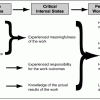

- There is an expectation that those with a job will have to work harder and longer to keep the job.

At the US automaker where I once worked, assembly plant shifts were scheduled back to back. If one shift finished at 3:00 pm, another was hard at work by 3:30. The plants' managers pushed hard to meet production quotas while minimizing input costs by keeping the line going pretty much all the time. The underlying productivity arithmetic is basic to any manager's: maximize output (cars), minimize inputs (labor, electricity to run the machines, etc.).
Advisor
Workload Management
The management of risk is like driving a car -- everyone believes they do it really well, but very few people actually do so.
