

Strategic advice to leverage new technologies
Technology is at the heart of nearly every enterprise, enabling new business models and strategies, and serving as the catalyst to industry convergence. Leveraging the right technology can improve business outcomes, providing intelligence and insights that help you make more informed and accurate decisions. From finding patterns in data through data science, to curating relevant insights with data analytics, to the predictive abilities and innumerable applications of AI, to solving challenging business problems with ML, NLP, and knowledge graphs, technology has brought decision-making to a more intelligent level. Keep pace with the technology trends, opportunities, applications, and real-world use cases that will move your organization closer to its transformation and business goals.
Insight

Executive Update
Securing the Client Side With Digital Tokens


This Advisor is a continuation of the "Scrum Ain't Enough" series (see "Agile Analytics: Community, Customers, and and Collaboration," 18 October 2011, and "
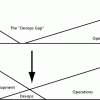
Devops as a cure for the dysfunctional gap between development and operations is here to stay. Complex applications built as an orchestration of highly distributed services, some internal, some outsourced, demand that development and operations find a common language in which to collaborate.

ONE PAINFUL RELEASE TOO MANY
Release 3.2 of our team's software product was the latest in a series of painful releases that had missed promised delivery dates. The pressure to get the thing out the door meant that our customers ran afoul of several bugs, forcing us to hurriedly squeeze out two bug fix releases in quick succession.

Big Enterprises
Cross-silo communication is harder in large enterprises, but they’re the ones that need it the most.
Small ChangesBad ITIL implementations often resist change because of risks, but making frequent, small changes can reduce the risks.
The ultimate victory will depend on the hearts and minds of the people who actually live out there.
-- US President Lyndon Baines Johnson
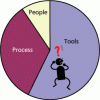
On the dev2ops blog (one of the primary locations for seminal devops thought), Alex Honor states his chosen methodology as "People over Process over Tools."1
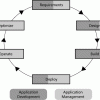


In this Cutter IT Journal article, seasoned agilist Scott Ambler points out that agile needs to become more enterprise aware and discusses an approach he calls "Disciplined Agile Delivery." Elements such as release and deployment should be integral parts of your agile vision and your daily activities. Keep a focus on the real business requirements not merely by developing software, but by providing a complete solution that can run stably in production. Not a member? Download your complimentary copy of this article when you complete our special offer form.