



Strategic advice to leverage new technologies
Technology is at the heart of nearly every enterprise, enabling new business models and strategies, and serving as the catalyst to industry convergence. Leveraging the right technology can improve business outcomes, providing intelligence and insights that help you make more informed and accurate decisions. From finding patterns in data through data science, to curating relevant insights with data analytics, to the predictive abilities and innumerable applications of AI, to solving challenging business problems with ML, NLP, and knowledge graphs, technology has brought decision-making to a more intelligent level. Keep pace with the technology trends, opportunities, applications, and real-world use cases that will move your organization closer to its transformation and business goals.
Insight




Last week, it was Oracle Corporation buying real-time data integration vendor GoldenGate Software, Inc. (see "Oracle Buys GoldenGate: Adds Real-Time Data Integration and 'Zero-Downtime' Migration Tools," 28 July 2009). This week, it's IBM acquiring data mining and statistical analysis tools vendor SPSS, Inc. for US $1.2 billion.
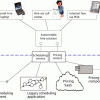

A harsh economic recession calling for renewed cost reduction with an emphasis on tactical solution-delivery projects causes concern over the effectiveness of enterprise service-oriented architecture (SOA) and puts agile back in the limelight. SOA and agile methodologies are commonly seen as opposites, but opposites that don't attract.
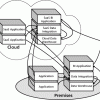

Abstract
Cloud computing describes the state of the art in data center infrastructure and its possibilities. As we explore in this Executive Report by Brian J. Dooley, the cloud provides some hope for handling some of the trickiest issues regarding business intelligence (BI).
Business intelligence (BI) has been evolving recently under the combined pressures of more sophisticated processing requirements, wider access for nonanalysts, and the increasing need for real-time analysis. The need for analysis is acute, yet meeting that need with the traditional enterprise data warehouse structure is viewed as increasingly problematic.

We read much these days about business process management (BPM) and service-oriented architecture (SOA) converging. Is that just hype, or does it really make sense? And if it does make sense, just what might that mean for our organization -- not just in terms of technology, but also in terms of that subtler, softer kind of thing we call "culture" -- the unwritten rules of the game?