


Strategic advice to leverage new technologies
Technology is at the heart of nearly every enterprise, enabling new business models and strategies, and serving as the catalyst to industry convergence. Leveraging the right technology can improve business outcomes, providing intelligence and insights that help you make more informed and accurate decisions. From finding patterns in data through data science, to curating relevant insights with data analytics, to the predictive abilities and innumerable applications of AI, to solving challenging business problems with ML, NLP, and knowledge graphs, technology has brought decision-making to a more intelligent level. Keep pace with the technology trends, opportunities, applications, and real-world use cases that will move your organization closer to its transformation and business goals.
Insight






Abstract
This Executive Report by Douglas K. Barry describes an incremental service-oriented architecture (SOA) technique that improves project selection in such a way that the chances of success for that project are also improved.
Recently, problems with service-oriented architecture (SOA) projects have been the focus of some public statements, ranging from one saying that 50% of SOA projects are a complete failure to reporting rage over the changes instituted as part of SOA projects. These seem to report a pretty dismal scenario. But is it reality?

Abstract
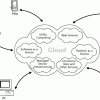
Although still a somewhat ambiguous term, "cloud computing" represents a watershed in both the evolution of outsourced service provision and in data center infrastructure. Public clouds provide outsourced services in a manner that incorporates efficiency, flexibility, scalability, and improvements in charging under a pay-as-you-go utility model.
Cloud computing has become the accepted name for the next evolutionary step of the data center and the services enabled by that infrastructure. It encompasses a range of service capabilities that can be provided to the enterprise and to individuals through a utility computing model by using multiple processors that are managed together as one, with access to services, provisioning, and management through the Internet.


In a recent BI Executive Update (see "Open Source BI and Data Warehousing: New Directions," Vol. 9, No. 2), I discussed the possible impact on the BI market caused by end-user organizations adopting open source BI tools.