



Strategic advice to leverage new technologies
Technology is at the heart of nearly every enterprise, enabling new business models and strategies, and serving as the catalyst to industry convergence. Leveraging the right technology can improve business outcomes, providing intelligence and insights that help you make more informed and accurate decisions. From finding patterns in data through data science, to curating relevant insights with data analytics, to the predictive abilities and innumerable applications of AI, to solving challenging business problems with ML, NLP, and knowledge graphs, technology has brought decision-making to a more intelligent level. Keep pace with the technology trends, opportunities, applications, and real-world use cases that will move your organization closer to its transformation and business goals.
Insight
Here is a question: "What will the computing environment of a midsize enterprise be in 2020?" That is, it seems to me, a fair question. The year 2020 is just about 11 years away (10 years if you're in government), and a decade is just a blink of the eye. What programming language will you be developing systems in: Java, .NET, Python, Ruby -- something else? What database management system will you be using? What computing platform will your organization be using: centralized, decentralized, on the cloud?

Here is a question: "What will the computing environment of a midsize enterprise be in 2020?" That is, it seems to me, a fair question. The year 2020 is just about 11 years away (10 years if you're in government), and a decade is just a blink of the eye. What programming language will you be developing systems in: Java, .NET, Python, Ruby -- something else?


Despite often-touted alternatives and real drawbacks, the enterprise data warehouse remains a very popular architecture for providing the data integration and management foundation for end-user organizations' BI environments. Moreover, my research indicates that use of enterprise data warehouses will continue to grow for the foreseeable future.
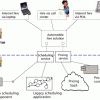

There has rightly been much focus of late on service-oriented architecture (SOA) governance and managing the risks of SOA.1 In this Executive Update, we explain how SOA -- properly done -- is in fact a powerful mechanism for managing both IT and business risks.

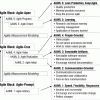
Many software development organizations have a growing realization that they need a more formal process than "seat of the pants." They are aware that many development methods are overly bureaucratic and unhelpful, particularly for small and medium-sized enterprises. They hear that agile processes may help, but how do they make the transition to a modern-day process? How do they determine how much agility the agile processes on offer today really possess? How do they determine how much agility they need, anyway?

If cloud computing wasn't the number-one IT buzzword in 2008, it had to be pretty close. In all likelihood, it will probably hold this place in 2009. But let's face it, cloud computing is still in its infancy. This becomes vividly apparent when you consider the almost complete lack of (open) standards pertaining to almost everything associated with using cloud architectures.


Are you ready for a fresh perspective on agility, architecture, and SOA? Then check out Building the Agile Enterprise with SOA, BPM and MBM, a book by Fred Cummins (Morgan Kaufmann, 2008). Don't let the title scare you away.