Strategic advice to leverage new technologies
Technology is at the heart of nearly every enterprise, enabling new business models and strategies, and serving as the catalyst to industry convergence. Leveraging the right technology can improve business outcomes, providing intelligence and insights that help you make more informed and accurate decisions. From finding patterns in data through data science, to curating relevant insights with data analytics, to the predictive abilities and innumerable applications of AI, to solving challenging business problems with ML, NLP, and knowledge graphs, technology has brought decision-making to a more intelligent level. Keep pace with the technology trends, opportunities, applications, and real-world use cases that will move your organization closer to its transformation and business goals.
Insight

Executive Summary
Enterprise Architecture as a Discipline for Strategy Execution
The accompanying Executive Report introduces an approach to solving the strategy-execution dilemma plaguing most businesses. This approach leverages the discipline of enterprise architecture (EA) as a tool to execute strategy.

The ability to target specific processes within your organization, change them, and then see those changes quickly reflected in your business systems is no longer a "nice to have" in today's business climate -- it's a "must have." Being tied to a homegrown or aging business system that manages your warehouse or supply chain limits the ability for your systems to rapidly conform to process changes quickly.


In recent years, with much anticipation, we have increasingly been hearing about the Semantic Web, yet it is a term whose definition continues to be rather fuzzy.

Data models, processes, and supporting applications lie at the heart of information architectures and as such are a central component of network-centric environments.
With the Internet and Web-based applications starting to change the way people access and use information and data, semantic technologies have been anticipated as the next paradigm shift for business intelligence.
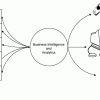

The BI landscape is shifting gradually to embrace new topic areas and empower new classes of users. Although this has been a gradual evolution, the end result could have revolutionary consequences. Historically, powerful technologies tend to become more widely applied and more readily used over time, with the results often proving unpredictable. Two of the clearest examples from the past century are the personal computer and the Web.




One of the main areas of development in EA and SOA this year has been in governance. Pundits describe the value and importance of governance, while vendors hawk solutions, as if governance were something we could actually buy. Lately, I've seen articles and presentations that espouse "Governance from Day One." This is one area where I disagree.