

Strategic advice to leverage new technologies
Technology is at the heart of nearly every enterprise, enabling new business models and strategies, and serving as the catalyst to industry convergence. Leveraging the right technology can improve business outcomes, providing intelligence and insights that help you make more informed and accurate decisions. From finding patterns in data through data science, to curating relevant insights with data analytics, to the predictive abilities and innumerable applications of AI, to solving challenging business problems with ML, NLP, and knowledge graphs, technology has brought decision-making to a more intelligent level. Keep pace with the technology trends, opportunities, applications, and real-world use cases that will move your organization closer to its transformation and business goals.
Insight
Executive Update
Overcoming Inventory Record Inaccuracy: An Alternative to RFID
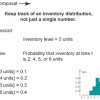
Automated decision support tools in retailing rely on the accuracy of inventory records -- records that track the number of units per item available for customer purchase. If the recorded quantity falls below the reorder point, a replenishment order is placed to restock store shelves. Not only do automated decision support tools determine when to place an order, they also use recorded inventory quantities to recommend how many units to order and to provide forecasts of future demand.



Service-oriented architectures (SOAs) are gaining momentum because they are perceived as the key for enterprises to achieve business agility, improved quality of service, quicker time to market, and lower total cost of ownership. While an SOA has the potential to deliver significant benefits to the business, those benefits do not come automatically.
Service-oriented architecture (SOA) has the potential to play a significant role in aligning business and IT and to deliver key benefits to the business. However, those benefits do not come automatically. The architecture needs to be defined following sound SOA guidelines, and the services must be designed according to service-oriented analysis and design (SOAD) principles, with loose coupling being one of the most important principles.
A true story: In a business landscape long ago and far away, I worked for a company1 that had multiyear software release cycles typical of the time. As we approached the exciting end of a major release of a "shrink-wrap" application, the conversation turned toward the next release. The decision was made that it was time to replace the application with a revolutionary start-from-scratch version. As I left for the birth of my first child, a battle over which of three operating systems to support first was beginning to rage.

This issue of CBR is devoted to what can no longer be qualified as an emerging trend: Agile software development. It has been over 10 years since the crystallization of the Agile principles, and many of our own respondents -- about half -- have already had some experience with it. Thus, we thought an issue on consolidating Agile efforts in your organizations -- or as we call it, making Agility stick -- would be beneficial to you.




In enterprise architecture, we're constantly challenged to overcome perceptions that we're in an "ivory tower" or being impractical or even irrelevant. In response, we should be looking for opportunities to provide value within the enterprise. Luckily, we're well suited with skills and well positioned organizationally to do so if we search out the right opportunities.