



Strategic advice to leverage new technologies
Technology is at the heart of nearly every enterprise, enabling new business models and strategies, and serving as the catalyst to industry convergence. Leveraging the right technology can improve business outcomes, providing intelligence and insights that help you make more informed and accurate decisions. From finding patterns in data through data science, to curating relevant insights with data analytics, to the predictive abilities and innumerable applications of AI, to solving challenging business problems with ML, NLP, and knowledge graphs, technology has brought decision-making to a more intelligent level. Keep pace with the technology trends, opportunities, applications, and real-world use cases that will move your organization closer to its transformation and business goals.
Insight
Although companies continue to express considerable interest in using neural networks and other advanced statistical modeling techniques for data mining and other BI applications, most organizations' BI and analytic practices rely primarily on standard reporting and multidimensional (OLAP) analysis methods.




Enterprise architecture is hard, no doubt. Anyone who has undertaken an EA effort can share stories of the many challenges they've faced.
Certainly, a familiar challenge is lack of buy-in. This may be encountered within the business and/or IT communities as disinterest, apathy, or even outright resistance. Why does this happen?

In recent years, service-oriented architecture (SOA) has become the hottest topic in the industry because of its promise of reuse, cost savings, and faster time to market, all of which are very appealing to a highly competitive marketplace. While the promises touted by SOA are not new -- as older generations of technologies such as CORBA remind us -- the means of achieving those goals through SOA must be fundamentally different.

Enterprise architecture management (EAM) and service-oriented architecture (SOA) mark two disciplines that belong to the IT plat du jour. Many organizations across the world are trying to implement SOA patterns and EA practices to reap the fruits promised by both disciplines.
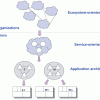

A business ecosystem, as introduced by James Moore [25], refers to the dynamic interaction of organizations in a community; over time, these groups co-evolve their capabilities and roles and tend to align themselves with the directions set by one or more companies that drive the evolution of the environment.
A business ecosystem refers to the dynamic interaction of organizations in a community; over time, these groups co-evolve their capabilities and roles and tend to align themselves with the directions set by one or more companies that drive the evolution of the environment.