


Strategic advice to leverage new technologies
Technology is at the heart of nearly every enterprise, enabling new business models and strategies, and serving as the catalyst to industry convergence. Leveraging the right technology can improve business outcomes, providing intelligence and insights that help you make more informed and accurate decisions. From finding patterns in data through data science, to curating relevant insights with data analytics, to the predictive abilities and innumerable applications of AI, to solving challenging business problems with ML, NLP, and knowledge graphs, technology has brought decision-making to a more intelligent level. Keep pace with the technology trends, opportunities, applications, and real-world use cases that will move your organization closer to its transformation and business goals.
Insight
In Part I (Vol. 10, No. 8) of this two-part Executive Update series on rich Internet applications (RIAs, pronounced ree-ahs), I lamented the way that the Web app tsunami set back user interface evolution by almost a decade, derailing architectural thinking and tossing us back to an essentially forms-based interface. But the situation is rapidly improving.


Warfare is often merely ontological.
Rightly or wrongly, Web 2.0 represents one of those paradigm shifts that is predictably precipitating a bit of warfare. People are arguing over how we ought to describe the world. And in every struggle, there are three main participants: protagonists who optimistically push forward, antagonists who skeptically critique the protagonists, and idle bystanders who either dismiss the significance of the entire scuffle or revel in the ensuing mud bath.
Web 2.0 represents one of those paradigm shifts that inevitably has people taking sides. Today, it appears most corporate enterprises are looking at Web 2.0 with a bit of bewilderment, if not some detachment. After all, the main participants in Web 2.0 are considerably younger than the executives who must make decisions regarding it. Many CIOs simply don't use technology in quite the same way as teenagers and young adults do and hence are not immersed in the Web 2.0 culture.


This is the second in a three-part series of Executive Updates on data management and analysis. In Part I (Vol. 7, No.

Today there are not many projects left that are developed "at home" without outsourcing or offshoring. Yet more and more projects are discovering that agile software development -- which emphasizes face-to-face communication -- is a critical success factor. How can these two trends be squared?
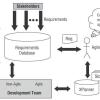

When introducing an agile approach to IT development into an environment that has known only a structured, start-to-finish, planned approach, you will likely encounter resistance. Thus, you will find yourself needing to compromise and adapt your methodological approach, to institute control points we call "traffic cops," and to learn to depict what you are delivering in a way that proponents of the previous "waterfall" methodology will not just understand but also accept.
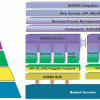

For many years, the Object Management Group (OMG), a major industry consortium focused on open computing standards, has played a key role in the development of groundbreaking standards in all areas of software engineering, including model driven development (MDD), software development processes (SDPs), enterprise architecture (EA), and systems integration (SI). Recently, OMG has been making major efforts to integrate all of these standards under its Model Driven Architecture (MDA) initiative.
Executive Summary
Integrating BPM and SOA: The Emerging Role of OMG and MDA
For many years, the Object Management Group (OMG) has played a key role in the development of groundbreaking standards in all areas of software engineering, including model driven development (MDD), software development processes (SDPs), enterprise architecture (EA), and systems integration. Recently, OMG has been making major efforts to integrate all of these standards under its Model Driven Architecture (MDA) initiative.