Strategic advice to leverage new technologies
Technology is at the heart of nearly every enterprise, enabling new business models and strategies, and serving as the catalyst to industry convergence. Leveraging the right technology can improve business outcomes, providing intelligence and insights that help you make more informed and accurate decisions. From finding patterns in data through data science, to curating relevant insights with data analytics, to the predictive abilities and innumerable applications of AI, to solving challenging business problems with ML, NLP, and knowledge graphs, technology has brought decision-making to a more intelligent level. Keep pace with the technology trends, opportunities, applications, and real-world use cases that will move your organization closer to its transformation and business goals.
Insight



Executive Update
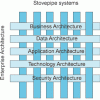
Enterprise Architecture: A Cross-Cutting Solution
In the application development culture, IT professionals like to interpret enterprise architecture (EA) as the blueprint for all application systems. As a result, EA can seem more complicated than it should be; and, as we all have learned, complexity increases exponentially with the scope of requirements.


If you follow astrology, you know that Gemini is the sign of the twins. And it's often said that Gemini have two sides: their good side and the other side -- the evil twin, which emerges at unexpected times, with undesirable results. I don't know if this is generally true about Gemini, but it is often true about other complex things.


Oracle's recent acquisition of analytic database and enterprise performance management (EPM) vendor Hyperion Software continues a trend in which the large, enterprise software vendors are aggressively moving to increase their presence in the market for BI tools and performance management applications.


Recently, a colleague asked me about my understanding of the reference architecture models for software-oriented architecture (SOA) initiatives. In particular, her question was related to how these architecture models stack up with other frameworks like information service bus (commercially known as enterprise service bus, or ESB).

You may have heard a big gasp the other day. That was the sound of Oracle Corporation sucking the air out of the other BI vendors' lungs with the announcement that it plans to buy business performance management and OLAP database vendor Hyperion Solutions Corporation for approximately US $3.3 billion.