

Strategic advice to leverage new technologies
Technology is at the heart of nearly every enterprise, enabling new business models and strategies, and serving as the catalyst to industry convergence. Leveraging the right technology can improve business outcomes, providing intelligence and insights that help you make more informed and accurate decisions. From finding patterns in data through data science, to curating relevant insights with data analytics, to the predictive abilities and innumerable applications of AI, to solving challenging business problems with ML, NLP, and knowledge graphs, technology has brought decision-making to a more intelligent level. Keep pace with the technology trends, opportunities, applications, and real-world use cases that will move your organization closer to its transformation and business goals.
Insight
Enterprise architecture (EA) has always been one of many terms with overloaded meaning. To some of us, EA is about "organizing multiple applications in an enterprise into a coherent whole" [1]. This view points out the difference between architecting an individual application versus architecting a collection of applications that support a business unit or an entire organization. It is not unlike comparing architecting a single building to working on an entire city plan.

One bit of news that seems to have slipped in under the radar screen is Informatica Corporation's announcement that it is buying unstructured and semi-structured data integration vendor Itemfield for US $55 million in cash. With this acquisition, Informatica now has the technology to transform its flagship PowerCenter product into a "universal data integration platform" that can handle structured, unstructured, and semi-structured data integration and transformation. From a market perspective, this is important.
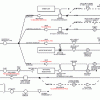

Reference model: A structure which allows the modules and interfaces of a system to be described in a consistent manner. [5]
Reference model: A standard definitive document or conceptual representation of a system or process. [2]
Business reference models (BRMs) are becoming a major tool that large organizations use to help them rapidly understand the current business processes, benchmark themselves against industry (global) best practices, and reengineer their businesses. BRMs provide a new kind of framework for looking at an organization's value chains, value streams, and major business processes without having to engage in full-blown, time-consuming business process modeling activities.

In December, we attended one of OMG's regular technical meetings, in part to see how its Model Driven Architecture (MDA) initiative is doing. We certainly can't claim impartiality in this respect as we recently published a book entitled Real-Life MDA: Solving Business Problems with Model Driven Architecture [1], in order to help accelerate the adoption of MDA in the IT industry. Nonetheless, we can safely say that, based on what we saw, MDA is rapidly becoming pretty mainstream.
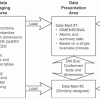
Executive Report
Do You Run from or to Embedded Business Intelligence?

The job of the modern CIO is tough. CIOs face tremendous pressure from their customers along many dimensions; the following are just a few of the many that come to mind:
-
Everyone wants their infrastructure applications, such as e-mail, to be reliable, easy to use, and always available.
-
Users of operational systems pressure the CIO to let them select the operational system that they think best meets their discrete needs.
Executive Summary
Do You Run from or to Embedded Business Intelligence?
Modern CIOs face tremendous pressure from customers for everything from ensuring infrastructure applications are reliable and easy to use to finding ways of doing more with less. The accompanying Executive Report focuses on an important emerging trend in complex enterprise software systems: embedded business intelligence (BI). This trend has the potential to dramatically alter the IT landscape and the pressures faced by the average CIO.
Executive Update
Enhancing Performance with BRMS
The business rules embedded in software are as old as programming itself. The logical statement if-then-else is an ancient and sacred mantra that directs software behavior and is rightfully attracting new attention with the emergence of business rules management systems (BRMS). Managers not familiar with BRMS would do well to acquaint themselves with this class of IT for several reasons, not the least of which is its potential strategic value in enhancing operational performance.