

Strategic advice to leverage new technologies
Technology is at the heart of nearly every enterprise, enabling new business models and strategies, and serving as the catalyst to industry convergence. Leveraging the right technology can improve business outcomes, providing intelligence and insights that help you make more informed and accurate decisions. From finding patterns in data through data science, to curating relevant insights with data analytics, to the predictive abilities and innumerable applications of AI, to solving challenging business problems with ML, NLP, and knowledge graphs, technology has brought decision-making to a more intelligent level. Keep pace with the technology trends, opportunities, applications, and real-world use cases that will move your organization closer to its transformation and business goals.
Insight
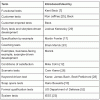
Executive Report
Driving Software Development with Executable Acceptance Tests
It is common knowledge that more than two-thirds of all software projects today do not succeed for a variety of reasons: they are either terminated, become obsolete, exceed time restrictions or budget, or deliver a reduced set of functionality. Ambiguous and incomplete software requirements along with insufficient testing are major contributors to these failures [51].
Executive Summary
Driving Software Development with Executable Acceptance Tests
The accompanying Executive Report provides an overview of executable acceptance test-driven development (EATDD), a software development methodology where automated tests are used to specify high-level functional requirements and drive the development.
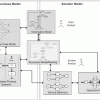

In my role as enterprise architecture (EA) and service-oriented architecture (SOA) consultant, some o
Many IT organizations are beginning to implement service-oriented architectures (SOAs), yet some
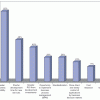

This is the third in a series of four Executive Updates in which I am analyzing the results of a recent Cutter Consortium survey on service-oriented architecture (SOA).

INTRODUCTION
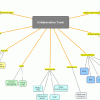
We are witnessing a boom in "social software" -- the next generation of online collaborative environments that leverage the vast wealth of connections in our networks. There is great potential for this type of software to be used in organizational and business contexts, provided collaboration is also well understood as a culture and a philosophy.
Part business, part IT, and part organizational science, collaboration is cropping up everywhere in organizations. As it is too hot to handle for any single department alone, it is bringing all parties to the discussion table. We are witnessing the pervasive emergence of "social software" and must learn how to incorporate this important trend in long-term organizational strategies.

Business modeling currently describes a vast territory with conflicting purposes, methods, and outcomes. Some of the confusion is historical -- as between financial modeling and models created specifically for software development, for example.