


Strategic advice to leverage new technologies
Technology is at the heart of nearly every enterprise, enabling new business models and strategies, and serving as the catalyst to industry convergence. Leveraging the right technology can improve business outcomes, providing intelligence and insights that help you make more informed and accurate decisions. From finding patterns in data through data science, to curating relevant insights with data analytics, to the predictive abilities and innumerable applications of AI, to solving challenging business problems with ML, NLP, and knowledge graphs, technology has brought decision-making to a more intelligent level. Keep pace with the technology trends, opportunities, applications, and real-world use cases that will move your organization closer to its transformation and business goals.
Insight

A survey Cutter Consortium conducted in November 2004 of 110 end-user organizations based worldwide reveals that companies are struggling to sufficiently plan for the end-user training requirements of their business performance management applications.
Advisor
Enterprise Scrum
Agile is becoming more widely accepted. Over the past six months, a number of large organizations have contacted me for help implementing Scrum within their enterprise. This has led me to ponder what a top-down implementation might look like.

SURVEY METHODS
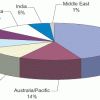
In examining BPM adoption trends, I focused specifically on end-user organizations. Therefore, I filtered out survey responses from software vendors and software services organizations that market BPM software products or assist organizations with BPM initiatives. Vendors and services firms typically apply new technologies (in assisting clients) to a greater extent than do end-user companies. This tends to skew survey results, giving the appearance that more end-user organizations implement the technology than is often the case.
Article
The Hidden Costs of BPM Projects
Hidden costs are the most difficult to predict but tend to have the gravest consequences. For a BPM project, hidden costs are those that remain undiscovered during the project definition phase but surface during implementation because of undisclosed management requirements or bias.

Business performance management has generated considerable interest among organizations worldwide. Is it just the latest IT buzzword destined to die out in a few months, or is it here to stay? In this issue of Cutter Benchmark Review, Cutter Consortium Senior Consultant Curt Hall presents the results of a recent study on the acceptance and benefits of BPM, predicting that the adoption of BPM practices will enjoy steady but moderate growth through the end of this year.
