

Strategic advice to leverage new technologies
Technology is at the heart of nearly every enterprise, enabling new business models and strategies, and serving as the catalyst to industry convergence. Leveraging the right technology can improve business outcomes, providing intelligence and insights that help you make more informed and accurate decisions. From finding patterns in data through data science, to curating relevant insights with data analytics, to the predictive abilities and innumerable applications of AI, to solving challenging business problems with ML, NLP, and knowledge graphs, technology has brought decision-making to a more intelligent level. Keep pace with the technology trends, opportunities, applications, and real-world use cases that will move your organization closer to its transformation and business goals.
Insight
With the wealth of information showering IT executives and managers daily, the need for simplicity is greater than ever. An executive in an environment where outsourcing is prominent must deal with service provider issues, plus worry about satisfying business customers, recruiting and retaining IT staff, and monitoring the project portfolio. Throw in operations issues, infrastructure improvements, and shrinking budgets, and you have a seriously overwhelmed individual.
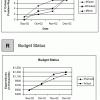
In the first part of this series, we described how project dashboards can be used to monitor project and portfolio status. Given a high-level view of a project's current status or the status of multiple projects, executives and managers can target questions and intervention into areas where measures indicate threats to success.


Most great athletes are born with great reaction times. Their ability to run faster, hit a ball farther, or avoid a tackle is often predicated on the fact that their neural system is simply faster than their opponents'. In a sense, the same thing is true about enterprises. Great businesses also seem to have great reaction times.
Historically, technology has always had a major impact on how businesses do business. The invention of the telegraph 150 years ago revolutionized how organizations communicated. It also made it possible for organizations to grow larger than had been possible before, coordinate over greater geographical spaces, and react faster.
Executive Update
Resident Expertise: Making the Most of Your Intellectual Property

Immediately following September 11, articles began appearing in the computer press saying that in order to prevent further terrorist attacks it was essential to provide the intelligence, law enforcement, customs, immigration, and other US government agencies with better data integration and sharing capabilities.

The movement toward e-business has involved a gradual evolution toward Web-enablement of all IT services and systems within the enterprise, integration of services, and centralization of access and management through a Web browser. This movement has coincided with advances in data analysis techniques to a point where diverse techniques applied to data stores might be deemed "business intelligence" (BI).