


Strategic advice to leverage new technologies
Technology is at the heart of nearly every enterprise, enabling new business models and strategies, and serving as the catalyst to industry convergence. Leveraging the right technology can improve business outcomes, providing intelligence and insights that help you make more informed and accurate decisions. From finding patterns in data through data science, to curating relevant insights with data analytics, to the predictive abilities and innumerable applications of AI, to solving challenging business problems with ML, NLP, and knowledge graphs, technology has brought decision-making to a more intelligent level. Keep pace with the technology trends, opportunities, applications, and real-world use cases that will move your organization closer to its transformation and business goals.
Insight
"Extreme" is a word that may naturally spring to your mind when you think of India. In this vast kaleidoscope of people and places, visitors and citizens are constantly exposed to the extremes of the human experience. Extreme is almost a way of life here. But is India's large and economically critical software industry ready to adopt the development practices of Extreme Programming (XP)?


Productivity benchmarking means comparing the productivity of your projects with the productivity of other similar projects. Productivity is an important measure of the performance of software projects in a portfolio. It is defined as the ratio of output to input. In software, this translates to the ratio of effort to develop a system over the size of the system.
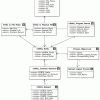
Here is a sample of the files used to establish links across lexical elements.

Editor's note: This discussion has been adapted from Bennatan's texts Software Project Management: A Practitioner's Approach (McGraw-Hill, 1992) and On Time Within Budget: Software Project Management Practices and Techniques, now in its third edition (John Wiley & Sons, 2000).
Caught in the frenetic rise of the dot-com phenomenon and following hot on the heels of Y2K, IT departments find themselves drowning in a sea of spaghetti logic and a Gordian knot of networked applications and legacy systems. As if that were not enough, the stock market deflation and the loss of business due to the tragic events of 9/11 have further shrunk much-needed IT budgets.
Caught in the frenetic rise of the dot-com phenomenon and following hot on the heels of Y2K, IT departments find themselves drowning in a sea of spaghetti logic and a Gordian knot of networked applications and legacy systems. The design of these IT applications has been tactical and not strategic. Few, if any, applications were designed in anticipation of the business processes they serve.