


Strategic advice to leverage new technologies
Technology is at the heart of nearly every enterprise, enabling new business models and strategies, and serving as the catalyst to industry convergence. Leveraging the right technology can improve business outcomes, providing intelligence and insights that help you make more informed and accurate decisions. From finding patterns in data through data science, to curating relevant insights with data analytics, to the predictive abilities and innumerable applications of AI, to solving challenging business problems with ML, NLP, and knowledge graphs, technology has brought decision-making to a more intelligent level. Keep pace with the technology trends, opportunities, applications, and real-world use cases that will move your organization closer to its transformation and business goals.
Insight

The Internet, and the emerging "hypernet" of networked applications and communication devices, are the backbone of the knowledge economy. Networked technologies are accelerating the shift in the economic foundation from the physical to the non-physical, changing the world conversation and allowing the natural pattern of organizations to emerge.

The interest in XML continues to grow. Like any young technology, everyone is exploring possible uses and no one is sure where the technology will provide significant payoffs. The XML enthusiasts believe there are hundreds of ways that XML can be successfully used. More conservative managers know that many things besides the technology determine if it will be successful.


Recently, I reported on a Cutter Consortium survey of 170 companies from around the world1 (see Distributed Enterprise Architecture Executive Update, Vol. 5, No. 1). Just over 40% of the companies are involved in software development or services, while the rest come from a cross-section of industries. In this article, I will continue to draw from this survey data to consider attitudes toward Web services.
Article
Web Services Paradigm
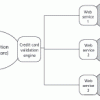
A Web service is a programmable entity that provides a particular element of functionality, such as application logic, and is accessible to any number of potentially disparate systems through the use of Internet standards, such as XML and HTTP.
As the next revolutionary advancement of the Internet, Web services will become the fundamental structure that links together all computing devices.
-- MSDN Library,
October 2001

Variation in your environment -- whether furniture, heating, air-conditioning, transportation, or your technology infrastructure -- is expensive. But although there are great savings embedded in standardized environments, the whole is fraught with emotion. Nearly everyone in your organization will have an opinion about what the company should do about operating systems, applications, hardware, software acquisition, services, and even system development lifecycles.

One message that comes through loud and clear from this month's CBR on Web services is that we (i.e., the IT industry) are not yet at all sure what we mean by these two words. Maybe that's not surprising. It is the latest buzz phrase, and judging from the data presented in the articles that follow, everybody is piling on this bandwagon (we may not know what it is, but most of us are pretty sure we're doing it). Buzz phrases are vague by nature, and when people start piling on, definitions usually get hazier.