

Strategic advice to leverage new technologies
Technology is at the heart of nearly every enterprise, enabling new business models and strategies, and serving as the catalyst to industry convergence. Leveraging the right technology can improve business outcomes, providing intelligence and insights that help you make more informed and accurate decisions. From finding patterns in data through data science, to curating relevant insights with data analytics, to the predictive abilities and innumerable applications of AI, to solving challenging business problems with ML, NLP, and knowledge graphs, technology has brought decision-making to a more intelligent level. Keep pace with the technology trends, opportunities, applications, and real-world use cases that will move your organization closer to its transformation and business goals.
Insight
Reviews, walkthroughs, and inspections are good practices -- resources. We can turn them into bad practices -- roadblocks. I've lived it both ways. I hope others can use some of the lessons learned.
The purpose of a review is to improve the product. We all make mistakes and other people can see my mistakes easier than I can.

A little more than a month ago I wouldn't have given a strange letter or package a second thought before immediately ripping it open. I sometimes receive mail that has some of the US Postal Service's suspicious signs: scribbled addresses, uneven and lopsided packaging, etc.
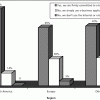

In September and October, I reported on the findings of a Cutter Consortium e-business survey. I addressed the commitment companies have to e-business (Executive Update, Vol. 4, No. 18); the types of applications being developed (Executive Update, Vol. 4, No.

As organizations are feeling pressure from the oscillating economic climate, changing government regulations, new customer demands, and high employee turnover, they are grasping at technology solutions to halt their steady loss of business knowledge -- business knowledge that was never complete or comprehensive in the first place.
A purported 60%-70% of business intelligence (BI) applications fail. The root causes for these failures are not related to the technology but to organizational, cultural, and infrastructure issues.
Over the past decades, organ-izations have adopted some unsound habits, which have produced disparate silo decision support systems with a great number of impairments.

Web data analysis has received considerable attention in the general computing and IT trade press, and it is frequently cited by business intelligence (BI) tool vendors as an application area for the use of their products.
Executive Update
The Hypercube: Organizing Intelligence in a Complex World
One form of the distinction between information and knowledge is that knowledge is information about how to connect information. Not uncommonly, the discovery of a pattern connecting previously unrelated bits of information occurs through serendipity. The churning of stuff through one's mental inbox generates random juxtapositions that can suddenly suggest new meanings to anyone ready to notice them.

This is the second in a series of three Advisors on methodology design.