

Strategic advice to leverage new technologies
Technology is at the heart of nearly every enterprise, enabling new business models and strategies, and serving as the catalyst to industry convergence. Leveraging the right technology can improve business outcomes, providing intelligence and insights that help you make more informed and accurate decisions. From finding patterns in data through data science, to curating relevant insights with data analytics, to the predictive abilities and innumerable applications of AI, to solving challenging business problems with ML, NLP, and knowledge graphs, technology has brought decision-making to a more intelligent level. Keep pace with the technology trends, opportunities, applications, and real-world use cases that will move your organization closer to its transformation and business goals.
Insight
Executive Summary
Designing Scalable Enterprise JavaBeans Applications
There's little doubt about the impact of the Internet in the past decade; it has been profound, forever changing the way people use computers, access information, and do business. Not as widely recognized is the impact the Internet has had on software development and IT systems. The impact on software professionals, practices, and technology is just as profound.
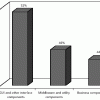

Increasingly, companies are turning to component-based development to create new applications. A few years ago, most companies were still doing object and component development in special groups and applying the techniques to carefully selected tasks. However, since the late 1990s, with the rise of the Internet and Java, component-based techniques have pretty much swept away the competition.
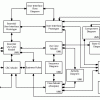

Agile modeling (AM), formerly known as extreme modeling (XM), describes a collection of values, principles, and practices for effective modeling of software systems. The approaches promoted by AM can be used to improve most software development projects, particularly those focused on the creation of business software, regardless of the software process that the project team has adopted.

Executive Update
Case Study: Using XML Schemas to Implement EAI Solutions
I am currently the application architect on a project whose purpose is to accept service orders from Web clients and implement those orders by triggering workflows in back-end legacy systems. The exact details of the client or the application are unimportant. What's important is that this is a typical enterprise application integration (EAI) scenario -- using a Web client to invoke end-to-end transactions via a workflow middle layer that ultimately uses back-end resources to perform its work.

Unless you've been stuck aboard the International Space Station for the past few days, you've probably heard that IBM is buying Informix Software's database business for a cool US $1 billion in cash. Lots of people have commented as to what this deal means in general for the database market, but what does it portend for IBM's data warehousing and BI business, as well as for the BI market in general?
Executive Report
Data Warehousing: Supporting Business Intelligence
Business intelligence (BI) is the set of processes and data structures used to understand a company's business environment in order to support strategic analysis and decisionmaking. The major components of BI are the data warehouse, data marts, decision support interface, and processes to collect data into the data warehouse and deliver it to the business community.
Executive Summary
Data Warehousing: Supporting Business Intelligence
Business intelligence (BI) is the set of processes and data structures used to understand a company's business environment and support strategic analysis and decisionmaking. The accompanying Executive Report describes the business value that BI capabilities provide, the architecture needed to support the environment, and a sound approach for building and managing it.
