

Strategic advice to leverage new technologies
Technology is at the heart of nearly every enterprise, enabling new business models and strategies, and serving as the catalyst to industry convergence. Leveraging the right technology can improve business outcomes, providing intelligence and insights that help you make more informed and accurate decisions. From finding patterns in data through data science, to curating relevant insights with data analytics, to the predictive abilities and innumerable applications of AI, to solving challenging business problems with ML, NLP, and knowledge graphs, technology has brought decision-making to a more intelligent level. Keep pace with the technology trends, opportunities, applications, and real-world use cases that will move your organization closer to its transformation and business goals.
Insight
Executive Update
Online Acceleration: An E-Business Case Study
This Executive Update provides a summary of the information presented by Hoa Nguyen at Cutter Consortium's recent symposium on e-business strategy. Nguyen presented a case study on Case Shiller Weiss (CSW), an organization that specializes in the research and analysis of the residential real estate market.

ENTERPRISE INFORMATION PORTALS: HOT AIR OR HOT TECHNOLOGY?
It seems as though everywhere I turn, there's another vendor offering an "enterprise information portal" product. Or someone has added a portal capability to their software, promising that their product will save us from information glut.
APPSMART FOR RAD SQL SERVER DATA MART IMPLEMENTATION
Every once in a while, I encounter a new product that makes me really appreciate my job. AppsCo Software's AppsMart is such a product. AppsMart is a rapid application development (RAD) environment for building Microsoft SQL Server 7 data mart applications.
Volume III, No. 11; November 1999
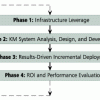
Knowledge management (KM), like any other complex organizational activity, cannot deliver business results without a concrete plan. Unfortunately, a disproportionately large number of companies that have been attempting to implement knowledge management have found the experience much like trying to nail jelly.
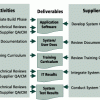
Dizzying changes in how companies are doing business and developing software are driving them to become learning, adaptive organizations. The notion of repeatability, while often misconstrued to mean "doing the same thing over and over again," really implies using previous experience in similar situations to make the best decisions for each project.

I find that concepts like knowledge mining of legacy business rules can seem abstract or threatening to people, but the concept is important nonetheless. Any organization with a large installed base of legacy systems should consider using business rule extraction, and the reuse of those rules, as a key component of future IT initiatives.
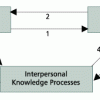

Enterprise modeling is being pulled into a new role in today's business. The application of modeling systems is being broadened: from the earlier focus on workflows and IT architecture, we are seeing a groundswell of interest in strategic goals, metrics, feedback cycles, and the other elements of what many call "strategic alignment."