


Strategic advice to leverage new technologies
Technology is at the heart of nearly every enterprise, enabling new business models and strategies, and serving as the catalyst to industry convergence. Leveraging the right technology can improve business outcomes, providing intelligence and insights that help you make more informed and accurate decisions. From finding patterns in data through data science, to curating relevant insights with data analytics, to the predictive abilities and innumerable applications of AI, to solving challenging business problems with ML, NLP, and knowledge graphs, technology has brought decision-making to a more intelligent level. Keep pace with the technology trends, opportunities, applications, and real-world use cases that will move your organization closer to its transformation and business goals.
Insight
WHERE THE INDUSTRY STANDS AND WHERE IT IS HEADING
The advent of distributed object computing (DOC) has been hailed as the harbinger of a vast market for plug-in components that represent the entities, processes, rules, and events that occur in the real-world business environment.
Article
Distributed Computing Overview
© Copyright 1999 Cutter Information Corp. All rights reserved. No part of this document may be reproduced in any manner without express written permission from Cutter Information Corp.

The practice of programmers' dragging and dropping GUI applications together, using component technologies such as ActiveX or JavaBeans controls, is increasingly commonplace. The IT marketing machine invites us to apply the same metaphor to full-scale business components: suddenly component-based development (CBD) is the latest hot topic.

NAVIGATING THE DISTRIBUTED COMPONENTS LANDSCAPE by Paul Harmon
The key to the way most companies think about distributed systems today is a ULect result of the current interest in the Internet.

In 1995, in a unanimous vote, the Object Management Group endorsed a specification for interoperability between OMG's Common Object Request Broker Architecture (CORBA) and Microsoft's Common Object Model (COM). The specification, known as CORBA/COM Interworking (CCI), is now implemented by dozens of products in use by thousands of end users.
DISTRIBUTED OBJECT COMPUTING: SPANNING THE ENTERPRISE AND BEYOND by David S.
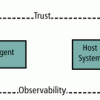
AGENT-BASED SYSTEMS
In traditional client-server settings, a central and trusted host communicates with statically bound client processes through either asynchronous messages or synchronous remote procedure calls.
PRACTICAL STRATEGIES FOR MIGRATING TO CBD by Paul Allen
The practice of programmers' dragging and dropping GUI applications together, using component technologies such as ActiveX or JavaBeans controls, is increasingly commonplace.