


Strategic advice to leverage new technologies
Technology is at the heart of nearly every enterprise, enabling new business models and strategies, and serving as the catalyst to industry convergence. Leveraging the right technology can improve business outcomes, providing intelligence and insights that help you make more informed and accurate decisions. From finding patterns in data through data science, to curating relevant insights with data analytics, to the predictive abilities and innumerable applications of AI, to solving challenging business problems with ML, NLP, and knowledge graphs, technology has brought decision-making to a more intelligent level. Keep pace with the technology trends, opportunities, applications, and real-world use cases that will move your organization closer to its transformation and business goals.
Insight
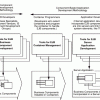
COMPONENT METHODOLOGIES by Paul Harmon
As everyone in the software community certainly knows, we live in times of very rapid change. In the early 1990s, I complained about the early OO methodologies and suggested that they were often just warmed-over, structured methodologies.

The growing excitement about Java in corporate IT departments has been closely followed by a growing concern about its performance. While numerous trade seminars, presentations, and articles have explored Java performance, very few have focused on real-world IT systems.

PINE CONE'S META EXCHANGE FOR DISTRIBUTED META DATA MANAGEMENT by Curt Hall
Everyone will tell you that meta data is the key to unlocking the potential of your data warehouse.
Volume X, No. 11; November 1998
PDF Version | ASCII Text Version
Advisory Service | Resource Center | Consortium Home
PDF Version | ASCII Text Version
Advisory Service | Resource Center | Consortium Home
JAVA COMMERCE: MONEY IN THE BANK? by Joe Kuriakose and Arthur Coleman
The rapid acceleration of technical innovation over the Internet is revolutionizing the way we do business.
REAL-WORLD JAVA FOR BUSINESS: The IBM SanFrancisco Application Business Components by Paul B.
JAVA PERFORMANCE IN THE REAL WORLD by Imran Sayeed
The growing excitement about Java in corporate IT departments has been closely followed by a growing concern about its performance.

This report is the first in a series that will examine how companies should approach their enterprise-wide transition from "traditional computing" to "component computing." In our view, this is one of the most critical transitions most organizations will make in the next decade, and it involves much more than the direct insertion of component-based tools, techniques, and middleware into the t