

Business Transformation Requires Transformational Leaders
Leadership and teaming skills are front and center in times of rapid change. Meet today’s constant disruption head on with expert guidance in leadership, business strategy, transformation, and innovation. Whether the disruption du jour is a digitally-driven upending of traditional business models, the pandemic-driven end to business as usual, or the change-driven challenge of staffing that meets your transformation plans — you’ll be prepared with cutting edge techniques and expert knowledge that enable strategic leadership.
Subscribe to Arthur D. Little's Culture & Leadership Newsletter
Insight
HATFIELDS AND MCCOYS:
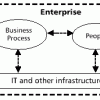
Businesses face an increasingly tough challenge to separate technology from business imperatives. A holistic approach that integrates the reality businesses face with their strategic direction and organizational health is urgently needed. This includes operational effectiveness and performance.

E-POWERING THE BUSINESS:

Intrapreneuring is a term that came into widespread use during the late, lamented dot-com boom. Merriam-Webster's Collegiate Dictionary, however, dates the term "intrapreneur" to 1982 and defines it thus: "a corporate executive who develops new enterprises within the corporation." But you could define it equally well by adapting the old joke about pioneers: How do you tell the intrapreneurs?

PINKY, THE BRAIN, AND STRATEGIC INVESTMENT MANAGEMENT by Marek Gmerski and Borys Stokalski
Before each night is done, their plan will be unfurled;
By the dawning of the sun, they'll take over the world.
Like the infamous southern US families, companies are split by the battles and bickering between IT and their internal business clients. Certainly, there is a history of bad blood, and both sides own some part of the blame for the over 30 years of turmoil. Passive aggression has become the weapon of choice, with both sides wielding it with expertise and enthusiasm.


A ROAD MAP FOR SUCCESSFULLY TRANSFORMING SMES

As hard as it is to believe, we are now in the third era of e-business -- the arrival of the Internet and online services in the competitive mainstream of every industry. The dot-com era came first. This was a real wake-up call for most "old economy" companies. Executives were concerned that the dot-coms would steal their customers, drive down prices, or dis-intermediate them. The result: era two.