

Business Transformation Requires Transformational Leaders
Leadership and teaming skills are front and center in times of rapid change. Meet today’s constant disruption head on with expert guidance in leadership, business strategy, transformation, and innovation. Whether the disruption du jour is a digitally-driven upending of traditional business models, the pandemic-driven end to business as usual, or the change-driven challenge of staffing that meets your transformation plans — you’ll be prepared with cutting edge techniques and expert knowledge that enable strategic leadership.
Subscribe to Arthur D. Little's Culture & Leadership Newsletter
Insight
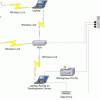
You are a certified project manager, with some years of experience and various successful projects. Now you are invited to manage a software project in a foreign country with a team including your usual staff as well as people at the client site.
Executive Update
The Middleware Mess
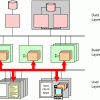
The Cutter Technology Council's Assertion #13 reads: "E-business and e-commerce will continue to fuel explosive growth in, and unending confusion about, the middleware portion of IT architectures." The purpose of this Executive Update is to consider whether there is evidence of this trend in industry today.
Today many organizations, especially in the US and Europe, execute software projects at overseas locations. These are commonly referred to as "offshore projects," and they offer attractive benefits -- leveraging the skills and resources available in the offshore country to cut costs and meet deadlines.

INTRODUCTION
In the early 1990s, Russian IT companies underwent a period of fast growth, which was caused by the rapid increase in demand for their services and the material absence of competition. At that time, most such companies employed accepted project management (PM) approaches similar to those offered by BAAN, SAP, Oracle, and Microsoft.
Executive Update
Project Governance: The Forgotten Component of Project Success
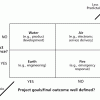
Attending yet another project management course seems to be a common reward for being part of a failed project. However, having served as a member of project teams, a project manager, a project director, and a member of several steering committees -- and having attended a number of project management courses -- I have begun to realize that most failures have little to do with the project manager's abilities.

It's hard to open a newspaper these days and not read about the purported economic slowdown. Indeed, anything compared to the ferocious growth of the 1990s would suffer. Pressures brought about from these conditions make negotiation very difficult for IT organizations under the gun.
Executive Report
Outsourcing in the Real World: Stories from the Front Line
We recently faced a dilemma while updating our outsourcing training program: how to find out how companies are really doing with outsourcing.
Executive Summary
Outsourcing in the Real World: Stories from the Front Line
Have you ever wondered if you could find out how companies are really doing with outsourcing? To answer that question, we created a list of we-always-wanted-to-know questions and conducted individual, face-to-face interviews with a select list of people who are involved in outsourcing.