


Business Transformation Requires Transformational Leaders
Leadership and teaming skills are front and center in times of rapid change. Meet today’s constant disruption head on with expert guidance in leadership, business strategy, transformation, and innovation. Whether the disruption du jour is a digitally-driven upending of traditional business models, the pandemic-driven end to business as usual, or the change-driven challenge of staffing that meets your transformation plans — you’ll be prepared with cutting edge techniques and expert knowledge that enable strategic leadership.
Subscribe to Arthur D. Little's Culture & Leadership Newsletter
Insight
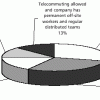
Telecommuting is both a familiar concept and a popular buzzword in today's high-tech, Internet-enabled society. As we suggested in a Cutter Consortium Business Technology Trends E-Mail Advisor last year (" Telecommuting Still Has a Long Way to Go," 9 November 2000):
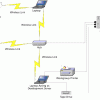
You are a certified project manager, with some years of experience and various successful projects. Now you are invited to manage a software project in a foreign country with a team including your usual staff as well as people at the client site.
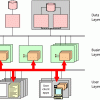
Executive Update
The Middleware Mess
The Cutter Technology Council's Assertion #13 reads: "E-business and e-commerce will continue to fuel explosive growth in, and unending confusion about, the middleware portion of IT architectures." The purpose of this Executive Update is to consider whether there is evidence of this trend in industry today.
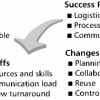
Today many organizations, especially in the US and Europe, execute software projects at overseas locations. These are commonly referred to as "offshore projects," and they offer attractive benefits -- leveraging the skills and resources available in the offshore country to cut costs and meet deadlines.
INTRODUCTION
In the early 1990s, Russian IT companies underwent a period of fast growth, which was caused by the rapid increase in demand for their services and the material absence of competition. At that time, most such companies employed accepted project management (PM) approaches similar to those offered by BAAN, SAP, Oracle, and Microsoft.

Aggressive schedules, evolving technology, rapidly changing requirements, uncertain business models, fixed-priced contracts -- pick out the term that seems incongruent with the others. "How do we write fixed-price contracts using agile methodologies?" is a question I hear frequently from clients and workshop participants. "Wrong question," is my usual reply.
Article
Outsourcing Risk Management
Although risk management is seen as a vital, integrated part of a project manager's skills, even in today's fast-paced, results- oriented environment, formal risk management for IT outsourcing is rare.
Advisor
Outsourcing Risk Management
Although risk management is seen as a vital, integrated part of a project manager's skills, even in today's fast-paced, results- oriented environment, formal risk management for IT outsourcing is rare.