


Business Transformation Requires Transformational Leaders
Leadership and teaming skills are front and center in times of rapid change. Meet today’s constant disruption head on with expert guidance in leadership, business strategy, transformation, and innovation. Whether the disruption du jour is a digitally-driven upending of traditional business models, the pandemic-driven end to business as usual, or the change-driven challenge of staffing that meets your transformation plans — you’ll be prepared with cutting edge techniques and expert knowledge that enable strategic leadership.
Subscribe to Arthur D. Little's Culture & Leadership Newsletter
Insight
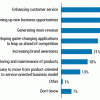
This Update examines survey findings pertaining to benefits and trends driving organizations to develop IoT-connected products, applications, and services; how organizations use or plan to use IoT applications, devices, and data; primary issues viewed as impeding corporate IoT initiatives.


In a culture of innovation, a culture in which "failure" has no useful meaning, a culture where we cannot predict the outcome of our work, we're going to have to get a new idea about efficiency. We will not "get it right the first time." Well, we might, but that would be an accident. No amount of planning and arrangements will guarantee a valuable outcome. What we used to abhor as failure becomes a fact of life, a key feature of our work processes. We must fit our expectations to the fact that of the things, services, and ideas we find innovative, many if not most will not display immediate value.

Consider this: when the IT world wrote its first line of code, there were no methods and we were “flying by the seat of our pants,” so to speak. Then came the structured systems analysis and design methods and entity-relationship modeling for relational structures. Later, the object-oriented methods and the formal project management through Prince-II and PMBOK all provided increasing sophistication in developing solutions but, at the same time, added overheads and bureaucracies to the way in which we worked.


As I explain in this Executive Update, service leadership is about doing the right thing for the right reasons and making principled, fact-based decisions.


I have to admit, I’m not a particular fan of metrics. Many managers still seem to believe that you can manage an organization by setting numerical objectives and tie them to financial bonuses. This approach has utterly failed; most prominently as one of the root causes of the ethical and economic breakdown of major parts of the financial industries in 2008.


Growing up, many of us remember walking to school alone, hanging out with friends in the park, and then, eventually, finding our way home for supper. Today, for children of the same age, such activities are considered dangerous or even illegal. It’s staggering. But norms change. The challenge for most of us is keeping up with the pace of change.


As we move into the next era of computing, the Internet of Things (IoT) is likely to continue to develop as a serious security challenge. The IoT has been characterized as simply the attachment of diverse devices to the Internet, but it is also the entry point for a much more complex and nuanced issue, as we discuss in this Executive Update.

We are seeing a serious push by vendors and organizations to incorporate machine learning (ML) techniques into both consumer and enterprise applications, where the technology is being applied to automate the analysis of large amounts of data, identify patterns, and learn preferences and behaviors.