



Business Transformation Requires Transformational Leaders
Leadership and teaming skills are front and center in times of rapid change. Meet today’s constant disruption head on with expert guidance in leadership, business strategy, transformation, and innovation. Whether the disruption du jour is a digitally-driven upending of traditional business models, the pandemic-driven end to business as usual, or the change-driven challenge of staffing that meets your transformation plans — you’ll be prepared with cutting edge techniques and expert knowledge that enable strategic leadership.
Subscribe to Arthur D. Little's Culture & Leadership Newsletter
Insight

As the cloud market has grown up, CIOs are now in a position to rely on a modern, robust ecosystem of cloud computing vendors to deliver efficiencies and cost savings at scale. To do this, however, the role of the CIO demands an understanding of how to build and subsequently manage that supply chain when deciding to procure infrastructure as a service. This article discusses how the CIO, ahead of launching an RFP, should prepare for the challenge of coordinating multiple, competing IaaS service offerings to establish the type of mature supply chain more commonly found in established utilities markets.


Many organizations, most notably the larger and more conservative companies, are still on the fence about moving their infrastructure to an IaaS model. IaaS can be deployed in different models, including on-premises and off-premises, managed by a third party or managed internally, and/or using private or public cloud environments. Which model(s) should an organization adopt? How do firms know if moving their hardware, software, servers, storage, and other infrastructure components to a third-party provider is right for them? Should they consider IaaS only for temporary or experimental workloads? Also worth considering and planning for are the technical/security risks, scalability, and legal/contract issues that are critical to a successful IaaS platform deployment. In this issue of Cutter IT Journal, our authors share their insights on the issues organizations should contemplate before moving to IaaS.


“In-silo” transformations of specific portfolios pose considerable challenges. This Executive Update offers some key considerations for the planning phase of such transformations and highlights a few challenges and possible solutions for the design and implementation of an in-silo operating model. [Not a Cutter Member? Download your complimentary copy here.]
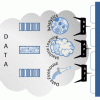

Today’s software systems are moving toward API access in what has come to be called the API economy. Analytics providers are now beginning to offer analytics APIs for use by organizational software departments, developers, and individuals.


Disruptive technologies unleash tremendous creativity, with effects far beyond the initial change. Successfully creating disruption requires more than just ideas and technical capacity; there's also cultural capacity.
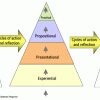


Based on the success that software development has achieved with Agile, enterprises are extending these practices beyond single software projects to increase innovation, responsiveness, and efficiencies for portfolios and enterprises. This has led to the expansion of Agile methods for enterprise projects and the expansion of Agile methods for portfolios. Existing techniques that support both "Classic Project Agile" and portfolio management form a foundation for Organizational Agility.
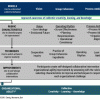
As we explore in this Executive Report, Organizational Agility™ is the capability of an enterprise or partnering enterprises to rapidly adapt to internal or external needs through collective creativity, learning, and knowledge. Groups can learn to recognize these collective characteristics using the models of vision, Group Coherence, and process ambidexterity. The targeted practice of Cooperative Inquiry, Group Coherence Ingredients, operating rhythm techniques, and Lean Six Sigma methodology develops Organizational Agility maturity. The Organizational Agility Maturity Rubric™ can be used to assess the maturity of Organizational Agility characteristics and target agility improvements.



In this Executive Update, we investigate the dynamics of digital payment platforms in the Danish market. Although our focus is on Denmark, the strategies we discuss likely generalize to a large extent to the entry and expansion strategies of digital payment solutions in other markets.