


Business Transformation Requires Transformational Leaders
Leadership and teaming skills are front and center in times of rapid change. Meet today’s constant disruption head on with expert guidance in leadership, business strategy, transformation, and innovation. Whether the disruption du jour is a digitally-driven upending of traditional business models, the pandemic-driven end to business as usual, or the change-driven challenge of staffing that meets your transformation plans — you’ll be prepared with cutting edge techniques and expert knowledge that enable strategic leadership.
Subscribe to Arthur D. Little's Culture & Leadership Newsletter
Insight
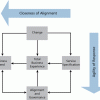

David Miller and Mark Woodman sketch out the Business and IT Relationship Model (BITRM) They introduce important concepts related to agility, governance, and management, tying it all together in the BITRM to prompt a change in the way we think about the nature of the business-IT union. This in turn leads to a new IT delivery model and a new way of IT management based on a total business experience.


Computing inspired by the design of brains is rapidly progressing. Very rapidly.
Executive Update
Leadership in IoT Enterprises
We are living in a time of technological revolution, globalization, uncertainty, and economic crises. The Internet of Things (IoT) is one such disruption. Consequently, there will be a demand for leadership in the fast-growing and disruptive IoT sector. In this Executive Update, we try to identify the leader's role in an IoT enterprise and point out potential leadership pitfalls.


Empowerment doesn't mean "do what you want" but rather "do what is needed to reach your goals."
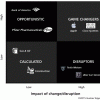

The ability to attain strategic and organizational agility directly relates to the organization's ability to prepare stakeholders for change. In other words, a sustained state of change readiness coincides with the ability to attain organizational agility. Among other practices, it is vital to manage change in an organized way that is pervasive and well understood across the organization.
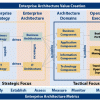

With the increasing adoption of enterprise architecture (EA), organizations face many challenges in how to measure and demonstrate the value that EA provides to an enterprise. This Executive Report describes a process for deriving EA value metrics that align with the value drivers particular to an organization -- those important to both the core business capabilities of the organization as well as its key stakeholders.
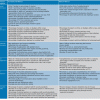
This Appendix to Methods for Defining and Analyzing Key EA Performance Metrics illustrates metrics that have been used to measure aspects of EA value.