


Business Transformation Requires Transformational Leaders
Leadership and teaming skills are front and center in times of rapid change. Meet today’s constant disruption head on with expert guidance in leadership, business strategy, transformation, and innovation. Whether the disruption du jour is a digitally-driven upending of traditional business models, the pandemic-driven end to business as usual, or the change-driven challenge of staffing that meets your transformation plans — you’ll be prepared with cutting edge techniques and expert knowledge that enable strategic leadership.
Subscribe to Arthur D. Little's Culture & Leadership Newsletter
Insight
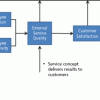
Today's customer is experienced, knowledgeable, demanding, and willing and able to defect to another company at the drop of a credit card. Frustrating customer experiences are rooted in customer-facing services designed from the inside (them)-out (you), absent of what's important to the customer, and more concerned with cost containment than with revenue opportunity.
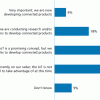

This Executive Update -- the final in a four-part series -- focuses on survey findings pertaining to the IoT, including how organizations view the IoT in terms of importance, IoT technologies that organizations deem most important for their business, and organizational support for wearable devices.


Google Executive Chairman Eric Schmidt told reporters at the most recent World Economic Forum in Davos-Klosters, Switzerland, that he saw the Internet disappearing over the next few years. What Schmidt was talking about, I believe, is not so much that the Internet's physical underlying structure would disappear but that the Internet would become so ubiquitous that it would be invisible.


In the era of big data, where assumptions are being challenged in all areas related to analytic processing, it is no surprise that new concepts should emerge to challenge the central role of the data warehouse in BI. The most recent is the data lake, which is viewed as a centralized repository of unstructured data held for processing by Hadoop and meeting the diverse needs of big data analysis. The data lake, like so many concepts in our industry, is currently undergoing subtle change as new technologies evolve to extend, fortify, and capitalize on the need that it is designed to fill.
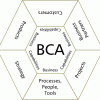

Andrew Guitarte never once promotes business architecture in this article. Instead, he introduces this subject as a given, weaving a tale about the "wicked problem" of portfolio management, and proceeds to employ the artifacts of business architecture as the means to tame this organizational monstrosity.

This article highlights a visible and real force -- Agile -- that is sometimes at odds with the notion of architecture. Author Daniel Horton, an Agile practitioner, speaks from experience, pointing out how architecture is sometimes completely absent from Agile projects. He also discusses situations where architecture exists but may as well not, seeming to operate in a parallel universe of its own.
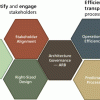

This article tackles the how-to of architecture governance. Mohan Babu K provides a veritable cookbook, chock full of frameworks and matrices, to help enterprises think through the various aspects of setting up an architecture review board, which is one of the most important components of architecture governance. Along the way, he draws out lessons from an actual implementation that he carried out for his company. If you are looking to set up or review your architecture review board, this article provides valuable guidance.

This article starts with a view of the digital society that is emerging and paints a picture of a "new style of IT." How can architecture deal with all this disruption? Peter Beijer describes the changes needed in the architecture function, in the discipline, and in the very profession itself. His article underscores that business architecture is an imperative, that a common language is needed to bridge the business-IT divide, and that architecture needs to be refocused as "a strategic instrument."