


Business Transformation Requires Transformational Leaders
Leadership and teaming skills are front and center in times of rapid change. Meet today’s constant disruption head on with expert guidance in leadership, business strategy, transformation, and innovation. Whether the disruption du jour is a digitally-driven upending of traditional business models, the pandemic-driven end to business as usual, or the change-driven challenge of staffing that meets your transformation plans — you’ll be prepared with cutting edge techniques and expert knowledge that enable strategic leadership.
Subscribe to Arthur D. Little's Culture & Leadership Newsletter
Insight
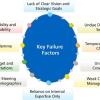
A business architecture function can be a sustainable option to design and implement transformation opportunities. Once an organization decides to take this path, it needs to ensure that the journey is smooth. In this Advisor (and in Figure 1), we highlight some pitfalls organizations should avoid when starting up the business architecture function:

It's an age-old story, which no one seems to question: any data is better than no data. This idea is absolutely wrong. The misconception may be borne of the accurate assessment that he who has data wins the argument against others who don't. But, we're not talking about using data, or measures, or information for the purpose of "winning" an argument. We're talking about using metrics for the purpose of winning in the battle for improvement. If we use measures properly, we do so to improve our business, organization, or our lives. In this respect, there are many times when having some data is not better than having none.


In current organizations that have a culture where relationships are highly valued and are most often maintained and developed through a lot of face-to-face interaction, the adoption rate for a digital platform for knowledge sharing and information integration is low. Organizations need to promote a culture that motivates staff to increase usage of digital platform for knowledge sharing. Here are some of the ways I would suggest organizations go about responding to that question.


Building trust and partnership requires credible performance, accountability, common goals, and clear roles for all partnership members, which happens when leadership -- both business and IT -- defines the relationship in these terms.

If we're honest with ourselves, we should admit that the record of IT projects is not that impressive. For years, industry analysts and academic researchers have reported that the majority of big technology projects fail by exceeding their budgets and missing important business requirements. 1 There's muscle memory here that absolutely, positively affects how the business perceives the value and competency of their technology organizations, their vendors, and their consultants. Worse, a lot of the "trust" between technology organizations and corporate business units -- which was perhaps always overstated -- has disappeared over the decades. In some companies, because of all of the failures, the business technology relationship is downright hostile.


For the better part of the last 20 years, I have worked on the business side of the great divide between IT and the business. My experience working with IT professionals ranges from strong strategic partnerships to hostile and deliberately antagonistic politics. Reflecting on both the good and the bad times, I have identified several patterns that I believe are critical to enabling the trust required to grow true partnerships.

"Trust" is a very strong -- even loaded -- word when it's applied to working relationships. It takes us beyond issues of competence and confidence into the realm of ethics. I may think a colleague is not very good at his job, or I may lack confidence in his ability to predict when something will be done, but that is not the same as feeling he could simply be lying to me. Trust does not take root immediately, and once lost, regaining it can take much longer.
The relationship between some IT departments and their business colleagues is adversarial rather than collaborative, resulting in mistrust and conflict instead of respect and cooperation. 1 One of the causes is the inability to agree on investment and project priorities, which leads to contentious or misunderstood decisions on schedules and resource allocation and almost inevitably to wasting funds on too many failed projects -- up to 70%, if surveys are to be believed. 2 Business colleagues believe their IT counterparts favor projects they want to do rather than those that are most important to the business, whilst IT people believe business "priorities" are not always based on sound justifications and change too frequently.