

Business Transformation Requires Transformational Leaders
Leadership and teaming skills are front and center in times of rapid change. Meet today’s constant disruption head on with expert guidance in leadership, business strategy, transformation, and innovation. Whether the disruption du jour is a digitally-driven upending of traditional business models, the pandemic-driven end to business as usual, or the change-driven challenge of staffing that meets your transformation plans — you’ll be prepared with cutting edge techniques and expert knowledge that enable strategic leadership.
Subscribe to Arthur D. Little's Culture & Leadership Newsletter
Insight


Building trust and partnership requires credible performance, accountability, common goals, and clear roles for all partnership members, which happens when leadership -- both business and IT -- defines the relationship in these terms.

If we're honest with ourselves, we should admit that the record of IT projects is not that impressive. For years, industry analysts and academic researchers have reported that the majority of big technology projects fail by exceeding their budgets and missing important business requirements. 1 There's muscle memory here that absolutely, positively affects how the business perceives the value and competency of their technology organizations, their vendors, and their consultants. Worse, a lot of the "trust" between technology organizations and corporate business units -- which was perhaps always overstated -- has disappeared over the decades. In some companies, because of all of the failures, the business technology relationship is downright hostile.


Rigidity in an organization can have a number of significant effects, including cultural as well as process issues. Without sufficient review, the organization can become brittle and less able to adequately respond to new conditions, while seemingly remaining in compliance with all imposing standards. The brittle organization will have problems in meeting changing business conditions, and it will also be less resilient and under greater threat from sudden problems such as natural disaster or catastrophic shifts in the market or in technology.
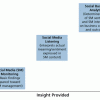

Taking advantage of social media insight requires integrating and analyzing social media in conjunction with enterprise data and correlating the findings. This Executive Report examines how social media analytics, when combined with traditional business analytics, can provide rich insights organizations can apply to a range of BI, CRM, marketing, product development, and other data analysis and performance management efforts.

The Internet of Things (IoT) is about more than just sensors and a lot of data and analytics (although these certainly are key components); it also involves the application of new technologies and practices like mobile devices, collaboration, and smart networks that are literally changing how businesses operate and people work. Lately, I've been examining how such technologies are having an impact in manufacturing, engineering, and other industrial environments.


The issue in negotiations is not about how we deal with senior executives or lawyers, accountants, or technical people. It is about how we deal with competitors, avoiders, compromisers, and so on. And there are many tricks and traps with each one. In this Executive Update, Dr. Sara Cullen looks at five styles that can affect negotiations more than expertise or seniority do.

At its core, leadership is an emotional process. To lead others, you must first develop self-awareness regarding your own emotional responses to situations and then the self-management skills to control those emotional responses in real time. After that, sharpen your senses so you can understand and manage the emotional responses of your followers. In order to strengthen people's ability to lead, help them develop greater capacity to understand and manage their own emotions, and then to understand and manage the emotional responses of those around them.


This Executive Update explains how leading enterprise architecture teams create EA governance by having a stronger focus on architecture.