
Business Transformation Requires Transformational Leaders
Leadership and teaming skills are front and center in times of rapid change. Meet today’s constant disruption head on with expert guidance in leadership, business strategy, transformation, and innovation. Whether the disruption du jour is a digitally-driven upending of traditional business models, the pandemic-driven end to business as usual, or the change-driven challenge of staffing that meets your transformation plans — you’ll be prepared with cutting edge techniques and expert knowledge that enable strategic leadership.
Subscribe to Arthur D. Little's Culture & Leadership Newsletter
Insight
This Executive Update invites you to reconsider a process-driven business process management methodology despite vendor training and previously conceived notions of how you plan and design for a BPMS.

When 20th-century German Physicist Theodor Kaluza decided to learn to swim, he is famously said to have read a book on swimming, and then jumped into the sea. For most people, the flaws of such a strategy are obvious: there is a big difference between skills-based knowledge and other forms of understanding.
As you will see in the practitioner article in this issue of CBR, our co-contributors Cutter Senior Consultant Claude Baudoin and Matt Ganis demonstrate the scale of innovation potential and the complexity surrounding the Internet of Things (IoT).
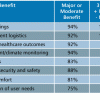


As much interest as there has been in what we call the "Internet of Things" (IoT), regardless of how we exactly define it, this is still very much an emerging technology, and opinions about it have not yet fully formed. The first thing we observed in the Cutter survey results on this topic is that many people simply do not have a strong opinion, or sufficient experience as of yet, to express a clear position. This was reflected in the low number of replies (48 respondents), which in itself is a notable fact.
Deriving firm conclusions from sparse input is almost impossible, of course.

It seems to me that the speed and success of the IoT's evolution will be driven largely by the willingness of early adopters to experiment -- and for them to share the results of both failure and success with each other. This was true for the Internet itself, for social media and Web 2.0, for the API economy, and so on. There is a tremendously important category of IT entirely predicated on integration and open standards -- and the IoT falls in this very category.


As has been our tradition for the last several years, we've compiled the five most intriguing articles published by the Business Technology Strategies practice this year for today's Advisor. How did we come up with this list? We chose the articles that garnered the most feedback from Cutter Members and clients and those that created controversy among Cutter Senior Consultants and Fellows.


Though rarely done, there is no reason why an entire IT organization should not encompass Agile principles. The transformation involves individual employees, teams, groups of teams, programs, management -- even customers -- and the outcomes can be astounding. This Executive Report describes that journey, from conception to successful completion. After laying ground rules, the report outlines a detailed three-phase incremental evolution. It serves as a guide through the entire organizational Agile terrain, pointing out common pitfalls, offering solutions to problems that will be encountered along the way, and providing case studies.
Until now, the focus of the Agile movement has been predominantly on teams and sometimes programs. Back in 2003, when Agile was not even widely accepted for software teams, my team and I began transforming entire IT organizations. As there was no precedent, these organizations learned from trial and error. This Executive Summary and its accompanying Executive Report compile knowledge gained through years of experiment and application, all of which led to proven effective practices. They provide directions and pointers that, if followed, will lead to a consistent and evolving Agile organization.