


Business Transformation Requires Transformational Leaders
Leadership and teaming skills are front and center in times of rapid change. Meet today’s constant disruption head on with expert guidance in leadership, business strategy, transformation, and innovation. Whether the disruption du jour is a digitally-driven upending of traditional business models, the pandemic-driven end to business as usual, or the change-driven challenge of staffing that meets your transformation plans — you’ll be prepared with cutting edge techniques and expert knowledge that enable strategic leadership.
Subscribe to Arthur D. Little's Culture & Leadership Newsletter
Insight
People made decisions for many millennia without the benefit of IT, and it's not self-evident that we make our really big decisions in the computer age consistently better than before. Smaller decisions, in relatively information-rich situations, are another matter. But IT, properly used, has become and will continue to be important to decision makers in critical ways:


We've recently noticed considerable discussion about the role of IT and the CIO in these turbulent, IT-intensive times. Generally, the discussion ranges from whether the CIO/IT will exist as a distinct, enterprise-level construct in the future, to "It's a technology management role" and on to quite lofty strategic business transformation/leadership roles for the CIO and senior IT folks.
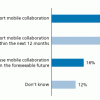

This Executive Update examines survey findings pertaining to the status of mobile collaboration in the enterprise; types of mobile collaboration platforms organizations use (i.e., on premise or cloud-based); and trends in functionality organizations seek to provide with their mobile collaboration platforms


There are a great many ways to consider software. For example, software can be thought of as pastime, a profession, or a science. Clearly, it can also be thought of as a branch of technological marketing. And one of the great software marketing coups of our time was the Agile Manifesto. Short and to the point, it asked its adherents to adopt a "new" approach, which combined a number of software organizational and management ideas, and which became the rallying cry of a generation of "Agile" developers and managers.
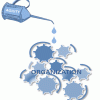

Agile development can be difficult to fit into existing practices because its management structure and oversight are different from traditional organization. Its team-oriented and self-organizing characteristics demand a high degree of cohesion within the team, but teams also need to fit the tasks at hand and exist within an overall organizational context.
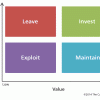

Here in Part II ir this Executive Update series, we continue with an enterprise view of SRM (rather than an interpersonal one) -- but from the supplier perspective. What do suppliers think of your organization? Do they even care if you consider them strategic or otherwise?
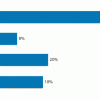
Mobility ranks high on the list of must-have technologies organizations are seeking to implement in the coming year. A recent Cutter Consortium survey (conducted in July–October 2014) that asked 49 organizations about their mobile technology practices and adoption plans helps shine some light on corporate mobility spending trends for 2015.


It’s that time of the year again —the annual Cutter Predicts … series. See what Cutter Fellows and Senior Consultants envision for 2015 (and in some cases, beyond) as business technology continues to morph.