


Business Transformation Requires Transformational Leaders
Leadership and teaming skills are front and center in times of rapid change. Meet today’s constant disruption head on with expert guidance in leadership, business strategy, transformation, and innovation. Whether the disruption du jour is a digitally-driven upending of traditional business models, the pandemic-driven end to business as usual, or the change-driven challenge of staffing that meets your transformation plans — you’ll be prepared with cutting edge techniques and expert knowledge that enable strategic leadership.
Subscribe to Arthur D. Little's Culture & Leadership Newsletter
Insight
The IoT should not be viewed as only a technological opportunity. It has the potential to transform how people and business interact in significant ways. Therefore, people must be placed at the center of the IoT conversation.
The Industrial Internet matters. It changes software, it changes systems, it changes the way the world is wired, it changes business models, and it changes the workforce. And one day soon, it will save lives.

This article provides an overview of the complexity and various architecture components that go into making the IoT platform.

In this article, Adam Justice reveals the Top 10 Design Issues you must keep in mind before jumping on the IoT bandwagon.

The combination of data (including open data) with apps often represents cooperation between an app developer and a database or data set designer. They may be working jointly on a single project, but very frequently each is working on a component (data set or app) that will be paired with other components (app or data set) that have not yet been thought of.
There's an important question to ask at this point: who is doing this work? The answer to this question gets into the new world of app development.


Not long ago, it was possible to sequester the enterprise behind its firewall and DMZ, creating a clear and defensible boundary. But mobility, cloud technologies, and social networking are eroding this separation.
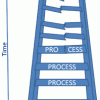
Standards and guidelines are essential for business and allow operations to be controlled, integrated with other business processes, and performed efficiently. But process standards and frameworks also can promote rigidity and brittleness in the face of change. It is this fear of rigidity that has kept many enterprises from implementing frameworks such as ITIL, though ITIL itself actually claims to be a nonprescriptive framework.


Reasons vary as to why the use of speech as a means for employees to interface with enterprise applications has received only limited use. Arguments run from limitations associated with the accuracy of early speech recognition systems to questions pertaining to their expected ROI in business scenarios. But I think the biggest reason has been the lack of a real need to actually use speech systems in the enterprise. Simply put, it has just been easier for employees to access most enterprise systems using a keyboard while they were at work; and this was the case for years.